
REVIEW · GUIDED
Narni: Guided underground Experience
Narni’s underground world packs a lot into a short visit: a forgotten church, prison cells, Roman water tunnels, and a Byzantine mosaic. You enter through an ancient underground church, then move through layers of the town that were lost, damaged, and slowly brought back to light.
I like the low price of $11, which makes this an easy add-on to a day in Narni. I also like the mix of archaeology and human stories, especially the prisoner graffiti left in a Holy Office cell. The main drawback is simple: the live guide speaks only Italian, so you will need the audio guide unless you understand Italian.
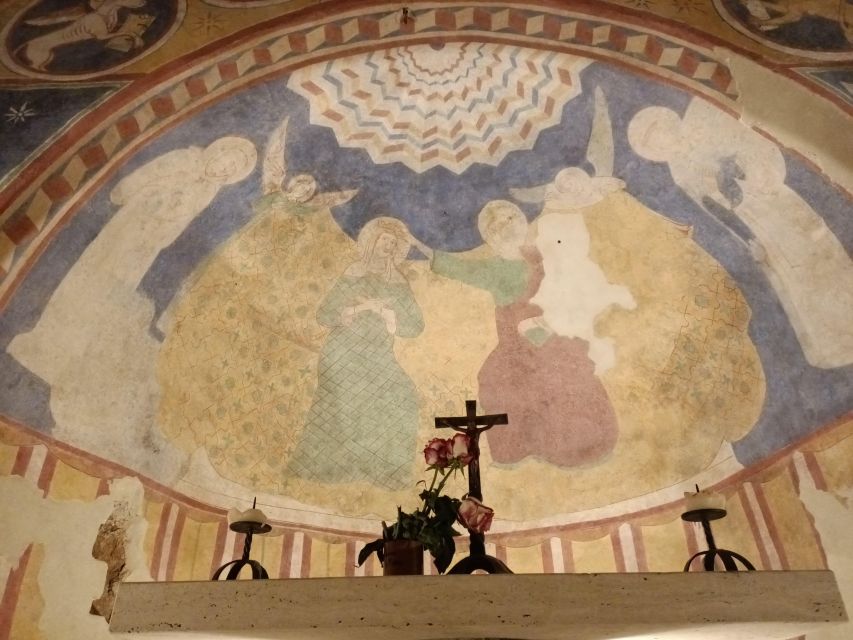
- A 13th-century church reveals frescoes once hidden beneath limestone.
- Roman Narnia’s aqueducts come alive through an interactive virtual tunnel.
- An intact Holy Office cell preserves prisoner graffiti and personal testimony.
- The upper church contains a Byzantine mosaic from Narni’s first cathedral.
- Italian is the only live tour language, with audio guides in four other languages.
- The one-hour visit offers strong value, but large bags are not allowed.
Entering Narni through its underground church
The visit begins at Via S. Bernardo, 12, in Narni’s old town. From there, you enter the basement of the former Dominican convent of Santa Maria Maggiore and the upper church that once served as the city’s first cathedral.
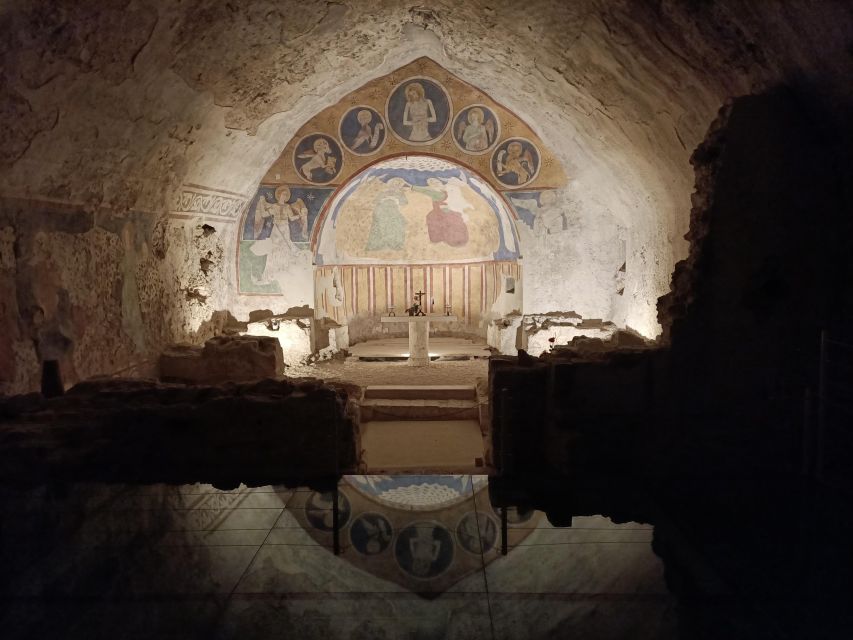
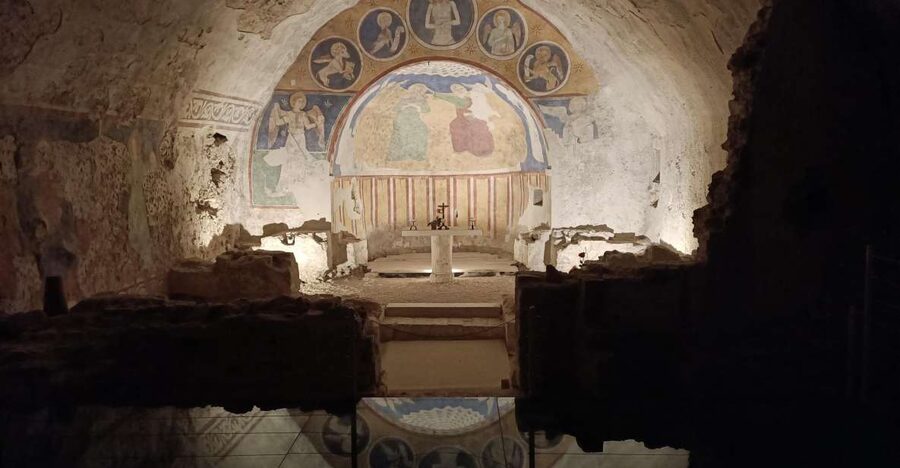
The first major stop is the underground church dedicated to the Archangel Michael. Its setting does much of the work. You are not looking at isolated objects in a display case. You are walking into a real religious space, built in the 13th century and later folded into the Dominican complex.
The church likely rests on older structures, which gives the room an extra layer of mystery. You can see how buildings in Italian hill towns often grow on top of one another, with one period using, altering, and sometimes burying the work of an earlier one.
A multimedia system helps explain the church’s different phases. This is useful because the walls alone cannot tell the whole story. Some of the site is visible, some has been restored, and some must be reconstructed through images and narration.
The presentation is part of the experience’s modern side. Some people will appreciate the extra context. If you prefer a strictly traditional tour, the videos may feel less important, especially since one Italian-language guide described the storytelling as theatrical and found some videos unnecessary. I would treat the multimedia portion as a support rather than the main reason to come.
Frescoes returning after years underground
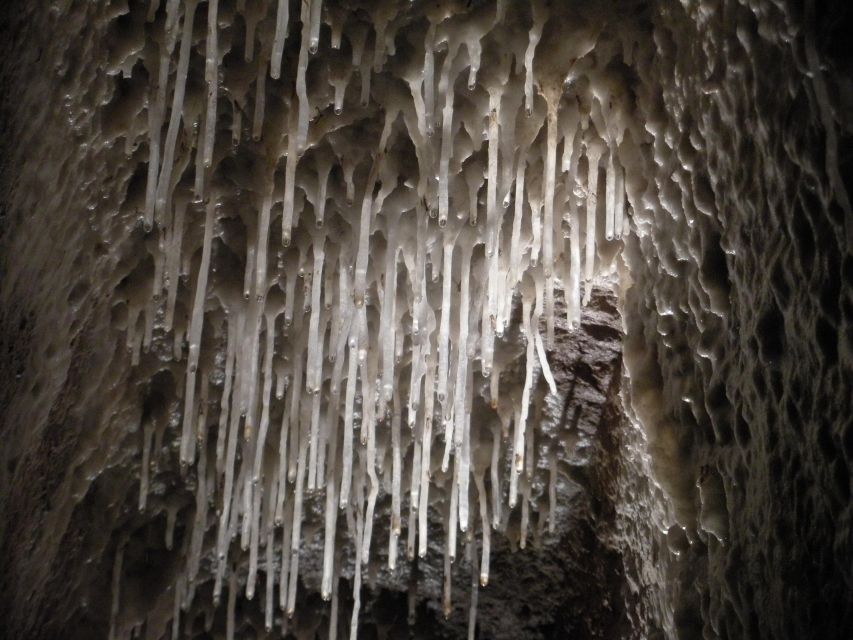
The church’s frescoes have had a difficult life. After the complex was looted in 1860 and damaged during World War II, it spent years neglected. Rainwater covered many of the paintings with limestone, leaving them hidden beneath a hard mineral coating.
Recent restoration work is slowly bringing those images back. You will not see every fresco as a bright, complete picture. That is part of the appeal. The surfaces show damage, age, and restoration in progress, and you get a clear sense of how much work it takes to recover art that was nearly lost.
The church was reconsecrated in 2000 under the name St. Mary of the Cliff. At that time, the original dedication had not yet been identified. Later research established its connection with the Archangel Michael, giving the site a clearer place in Narni’s religious story.
Six young people from Narni discovered the underground site in 1979. Since then, volunteers have helped clear, restore, and improve it. That volunteer effort matters. The attraction does not feel like a polished monument detached from the town. It feels like a local recovery project that has grown over many years.
If you enjoy seeing restoration as it happens, you will find plenty to study. If you want perfect paintings and a fully rebuilt interior, adjust your expectations before you arrive.
More Guided Tours in Italy:
- Naples: Naples Underground Entry Ticket and Guided Tour
★ 4.4 · 21,781 reviews - Naples: Catacombs of San Gennaro Entry Ticket & Guided Tour
★ 4.6 · 7,941 reviews - Naples: Spanish Quarters Underground Guided Tour
★ 4.8 · 5,064 reviews
Roman aqueducts from inside a virtual tunnel
In the next room, an interactive video explains how Roman aqueduct tunnels were excavated in ancient Narnia. You can virtually enter one of these underground passages and see how water systems were created below the city.
This section gives the visit a useful change of pace. The church focuses on worship, art, and later religious use. The aqueduct presentation reaches farther back and shows the practical side of Roman life.
You are not physically walking through a Roman aqueduct during this part. The tunnel is presented through an interactive system. That distinction matters if you are booking this experience mainly for an underground walk. You will get an explanation and a virtual look rather than a long passage through an actual water channel.
Still, the display helps you understand the town beneath your feet. Narni is not only a medieval hill town with churches and alleys. Its underground spaces also reflect Roman engineering and the need to move water through difficult ground.
I find this a good example of the tour’s overall method. It combines real rooms with multimedia where the original structure cannot be entered or shown in full. The result is more varied than a standard church visit, though the technology will appeal more to some people than to others.
The Holy Office cell and its wall graffiti
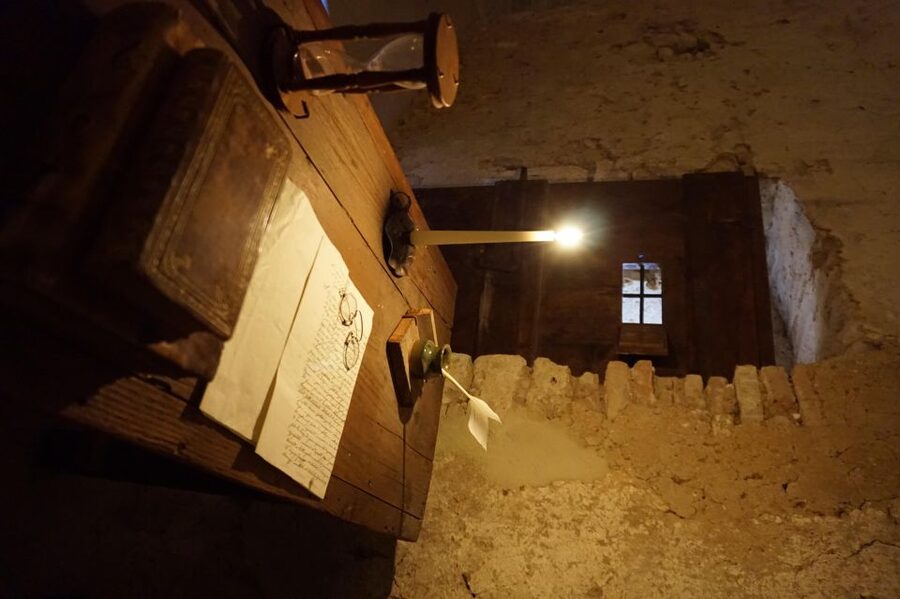
The most arresting section is the former dungeon of the Holy Office, the institution created to combat heresy. One cell remains intact, narrow and stark.
Here, the story becomes personal. Prisoners scratched graffiti into the walls, leaving marks that outlasted the people who made them. With help from the Vatican Archives, the history of some prisoners has been reconstructed, allowing the inscriptions to be connected with real individuals and events.
This is where the experience moves beyond dates and architectural labels. A cell can look small and plain, but the writing on its walls gives it emotional weight. You are looking at a record made under pressure, in a place designed to confine people.
The space is not presented as a lighthearted attraction. It is one of the parts I would take seriously, especially if you are interested in the history of the Inquisition, religious conflict, or the lives of ordinary people caught in larger institutions.
The guide’s style may shape how you feel about this section. Recent Italian tours have been praised for engaging storytelling, with Letizia singled out for using expression and gesture to hold the group’s attention. Another opinion found the presentation too theatrical and preferred a more restrained explanation. If you like animated storytelling, that energy may bring the cell’s history to life. If you prefer a quiet, academic tone, the audio guide may suit you better.
The upper church and Narni’s first cathedral
The route continues upward to the church connected with Narni’s first cathedral. This portion gives you a useful contrast with the darker underground rooms.
The main prize here is a Byzantine mosaic, along with other remains and frescoes. The mosaic helps establish Narni’s place in the early Christian world and shows that the city’s religious importance predates the Dominican convent.
You will also see more fragments rather than a fully preserved church interior. That can require patience. Look closely at the surviving pieces, and remember that the point is not simply to see a complete picture. The value lies in the way the remains reveal how the building changed over time.
The upper church also helps tie the visit together. Underground, you see forgotten rooms and hidden evidence. Above, you see the formal religious setting that once served the city. The two spaces make more sense when visited together.
The tour is described as a visit in which you are not merely watching events but taking an active role in the story. That idea works best when you pay attention to the transitions between rooms. The site asks you to picture how worship, water supply, convent life, imprisonment, war, and restoration occupied the same compact area at different times.
A few more cave trips around Italy worth a look
- Colosseum: Underground and Ancient Rome Tour
★ 4.7 · 12,691 reviews - Rome: Capuchin Crypts and Catacombs Tour with Transfers
★ 4.6 · 6,456 reviews - Expert Guided Tour of Colosseum Arena OR Underground, and Forum
★ 4.5 · 5,041 reviews - The Original Roman Crypts and Catacombs Tour with Transfers
★ 4.5 · 4,896 reviews
What the one-hour format really gives you
The stated duration is one hour, though the itinerary information also describes a visit lasting about an hour and a half. I would allow extra time rather than schedule a tight connection immediately afterward.
At $11 per person, this is one of the better-value cultural stops you can add in Narni. The price covers access to several distinct spaces, the multimedia material, and an audio guide in Italian, English, French, German, or Spanish. You also receive a card offering discounts at restaurants in Narni.
The value comes from variety. For the cost of a modest meal or coffee stop, you get a church, frescoes, a virtual Roman tunnel, a prison cell, and a cathedral mosaic. You are not paying only to enter one room.
The one-hour format also makes the visit easy to fit into a day of exploring Narni. You can pair it with a walk through town without giving up half a day. At the same time, the short schedule means the tour moves through several subjects quickly. If one section catches your interest, you may wish for more time to study the details.
Separate entry is available for those who reserve, which can help when the town is busy. Large bags and luggage are not allowed, so leave bulky items elsewhere before arriving.
Language, guiding style, and what to expect
The live guided visit is only in Italian. This is the most important booking detail.
Audio guides are available in English, French, German, and Spanish. Texts in other languages are also available. If you do not understand Italian, select the audio guide and expect to follow the route through recorded explanations rather than a live guide speaking your language.
English, French, German, and Spanish live tours can be arranged for groups of at least 20 people by reservation. That option is different from the standard individual visit, so do not assume you will arrive and find an English-speaking guide.
The Italian guides appear to use a lively storytelling style. Letizia has been praised for her enthusiasm, expression, and ability to keep the whole group focused. That style can make the complicated history easier to follow, but it may feel more dramatic than some people prefer.
I would choose the live Italian tour if you understand enough Italian to follow a fast-moving explanation and enjoy performance-style storytelling. Otherwise, use the audio guide and take your time with the frescoes, graffiti, and architectural remains.
Access, timing, and practical limits
The meeting point is Via S. Bernardo, 12, in Narni. Hotel pickup and drop-off are not included, and food and drinks are not part of the experience.
The information gives two different signals about mobility. Reserved access with an Italian guided tour is described as available for people using wheelchairs, while the activity is also marked as unsuitable for people with mobility impairments. Because the route includes underground rooms, steps or tight passages may affect what you can comfortably visit.
If access is important to you, contact the provider before paying and ask exactly which sections are wheelchair accessible on your chosen date. Do not rely on the general accessibility note alone.
Large luggage and bags are not allowed. Bring only what you need for the visit. This is especially practical in narrow underground areas, where bulky items would be awkward and could block the group.
You can cancel up to 24 hours before the start for a full refund, and the reserve-now, pay-later option lets you hold a place without paying at once. Those terms are useful if your Narni plans depend on train connections, weather, or a changing day schedule.
Who will enjoy Narni Underground most
I would recommend this experience if you like places that show several periods in one visit. The route links Roman engineering, medieval worship, Dominican life, religious courts, war damage, and modern restoration.
It suits you especially well if you enjoy:
- Small archaeological sites with a strong local connection
- Frescoes and mosaics in imperfect, partly restored settings
- Prison history and wall inscriptions
- Multimedia explanations of spaces you cannot physically enter
- Short cultural visits that fit around a larger town walk
- Guided storytelling rather than silent viewing
You may want to skip it if you dislike enclosed spaces, cannot manage the physical route, or want a fully English-speaking guide. You may also find the multimedia elements less appealing if you prefer artifacts and architecture without video support.
The C.S. Lewis connection may interest readers looking for the magical places associated with his stories, but the strongest reasons to visit are the actual remains: the church, the prisoner graffiti, the aqueduct presentation, and the Byzantine mosaic.
Should you book this Narni experience?
Book it if you want to see a side of Narni that ordinary street wandering will not reveal. The price is modest, the subject matter is varied, and the Holy Office cell gives the visit a memorable human edge.
I would reserve ahead, especially if you need a particular language option or want guaranteed entry. Choose the audio guide if you do not speak Italian, and allow more than the advertised hour if you like to pause over the frescoes and inscriptions.
Skip it if your schedule is extremely tight, if underground spaces are uncomfortable for you, or if you need a live guide in English as an individual. For most people who can manage the route and accept the Italian-only guiding, this is a smart $11 addition to a day in Narni.
FAQ
Where does the Narni Underground experience start?
The meeting point is Via S. Bernardo, 12, in Narni.
How long does the experience last?
The activity is listed as lasting one hour. The itinerary also describes a visit of about one and a half hours, so allow some extra time.
Is the guided tour available in English?
The live guided visit is only in Italian. Audio guides are available in English, French, German, and Spanish.
Can I arrange a live tour in English?
Live tours in English, French, German, and Spanish are available by reservation for groups of at least 20 people.
What does the tour include?
It includes reserved access, the guided visit in Italian, audio guides in English, French, German, and Spanish, texts in other languages, and a discount card for restaurants in Narni.
Can I bring luggage or a large bag?
No. Luggage and large bags are not allowed.
Is the experience suitable for people with mobility impairments?
The information is mixed. Reserved access is described as available for wheelchair users, but the activity is also marked as unsuitable for people with mobility impairments. Contact the provider before booking to confirm the route and accessible sections.
Just added around Italy
- Capri & Blue Grotto: Full-Day Tour with Guided Island Exploration★ 5.0 · 74 reviews
- Private Capri, Anacapri and Blue Grotto Tour from Capri★ 4.5 · 29 reviews
- Boat Tour of the Caves on the Island of Capri★ 4.5 · 463 reviews
- Paddleboard in Capri between caves and beaches. Photos included!★ 5.0 · 39 reviews
- Private Tour of the Island of Capri by Boat and Visit to the Caves★ 4.5 · 31 reviews
- Blue Grotto and Capri Boat Tour with Aperitivo Swim and Snorkel★ 4.5 · 47 reviews
- Capri Adventure Cruise: Sea Caves, Coastline & Blue Grotto Visit★ 5.0 · 18 reviews
- Small Group Tour to Blue Grotto, Anacapri and Capri★ 5.0 · 115 reviews
Guided, compared.
Naples: Naples Underground Entry Ticket and Guided Tour
Read our review →
Naples: Catacombs of San Gennaro Entry Ticket & Guided Tour
Read our review →
Krakow: Wieliczka Salt Mine Fast-Track Ticket & Guided Tour
Read our review →
Naples: Spanish Quarters Underground Guided Tour
Read our review →
Expert Guided Tour of Colosseum Arena OR Underground, and Forum
Read our review →
Rome: Colosseum Underground Small Group Guided Tour
Read our review →
Krakow to Wieliczka: Salt Mine Guided Tour with Ticket & Transfer
Read our review →Browse the lists this tour appears in