
REVIEW · LECCE
Lecce guided tour with underground discoveries
Lecce’s most surprising story is below street level. This two-hour walk pairs the city’s ornate Baroque churches and palaces with the Faggiano Archaeological Museum, where excavations beneath a private building reveal older layers of daily life. I especially like the contrast between grand facades above ground and the practical, buried remains below.
I also like the strong architectural focus and the guides’ clear, personal style. Fabio Grasso is praised for explaining buildings as both an architect and historian, while Elena, Ilenia, Antonella, Francesca, and Fabrizio are noted for their patience, enthusiasm, and clear English. The main drawback is the title: the underground portion is part of the museum visit at the end, not a long subterranean expedition.
Key points to know
- Piazza Duomo gives you a powerful first look at Lecce’s Baroque style, with the cathedral and bell tower framed within one of Italy’s most striking squares.
- Santa Croce rewards close attention, since the guide explains the meaning behind details that are easy to miss when you look only at the facade.
- The Faggiano Archaeological Museum adds a different kind of history, with excavated remains and artifacts beneath a building in the old center.
- Guides are the tour’s strongest feature, especially Fabio Grasso, Elena, Ilenia, Francesca, Antonella, and Fabrizio, all praised for clear explanations and lively delivery.
- The group is generally kept to a manageable size, with one review describing a group of 10 to 12 people.
- The $41 price is reasonable if you want context, not just a quick walk past Lecce’s churches and squares.
Why this Lecce tour works so well
Lecce can be admired in five minutes, but it takes longer to understand. The pale local stone, curling foliage, cherubs, columns, balconies, and carved animals are easy to photograph. The harder part is seeing how the city’s churches, noble homes, public squares, and older remains fit together.
That is where this guided walk earns its price. You are not simply pointed toward a handsome building. The guide explains how the Baroque style shaped Lecce, why religious and civic buildings received such elaborate decoration, and how the old center developed over time.
The tour lasts two hours, long enough to connect several major sights without turning into an all-day lecture. You walk through cobbled streets and stop at important buildings, so comfortable shoes matter. Lecce’s center is compact, but the stone paving can be uneven, and standing outside in the summer sun can become tiring.
The score of 4.5 from 230 ratings reflects a consistently strong experience, with the praise focused less on the route itself than on the people leading it. That distinction matters. A self-guided walk can show you the same streets, but it may not explain why a facade looks the way it does or what lies beneath it.
More Guided Tours in Italy:
- Naples: Naples Underground Entry Ticket and Guided Tour
★ 4.4 · 21,781 reviews - Naples: Catacombs of San Gennaro Entry Ticket & Guided Tour
★ 4.6 · 7,941 reviews - Naples: Spanish Quarters Underground Guided Tour
★ 4.8 · 5,064 reviews
Piazza Duomo and the first lesson in Baroque Lecce
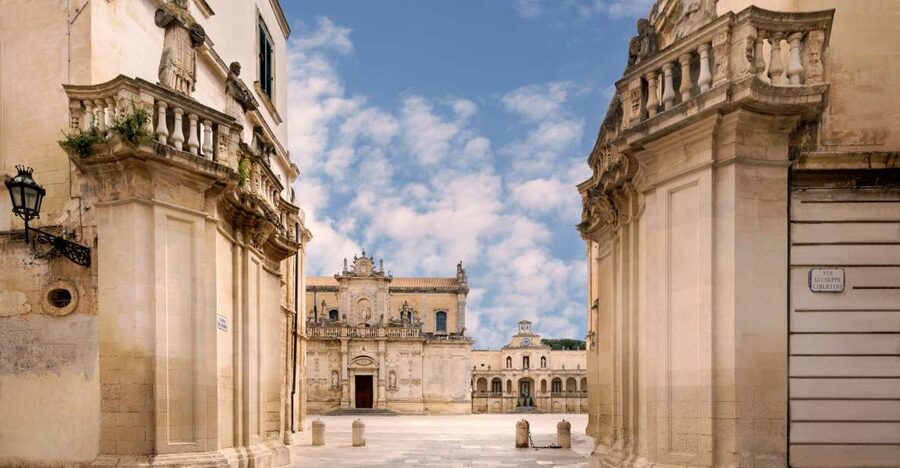
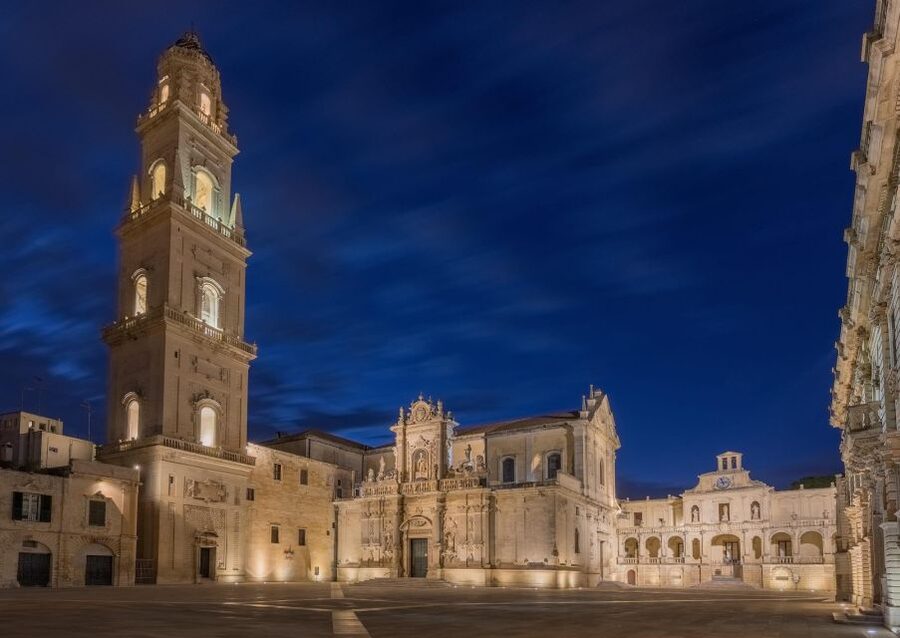
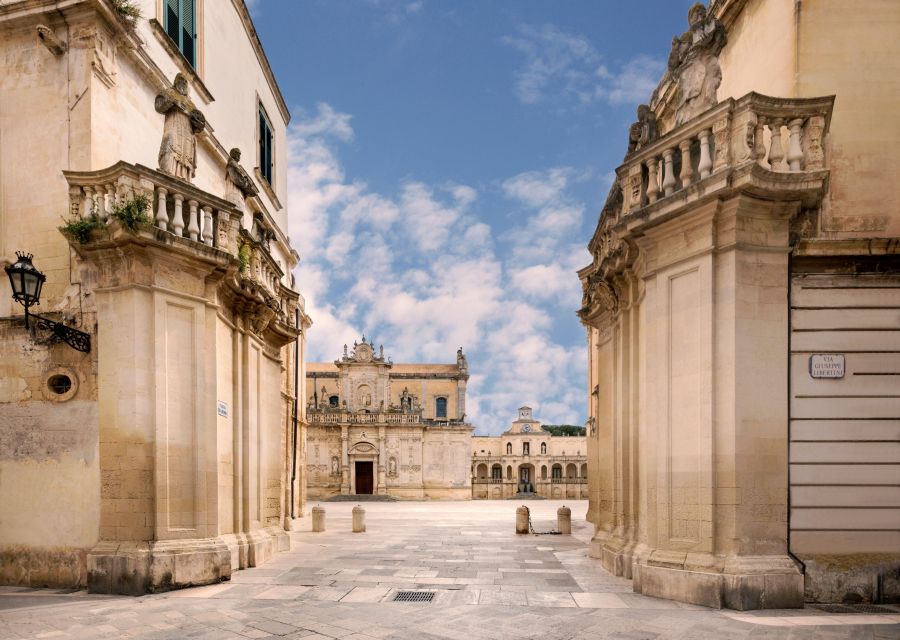
Piazza Duomo is one of the tour’s essential stops. The square presents the Cathedral of Lecce, its bell tower, and related church architecture in a contained setting. Rather than seeing one building at a time from a crowded street, you get a composed view of the religious center.
The bell tower is an especially useful reference point. It helps you understand Lecce’s scale and gives the guide a chance to explain the city’s Baroque character before the walk continues through narrower streets.
This is also where a guide can make the difference between decoration and meaning. Baroque design is full of movement and detail, but without context it can blur into a mass of carved stone. A good explanation gives your eyes a job: look for repeated symbols, notice how figures are arranged, and compare the grand public face of the city with the tighter residential streets around it.
If you have limited time in Lecce, this opening stop quickly gives you the city’s visual language. It is a smart beginning because later churches and palaces make more sense once you have seen the style gathered in one place.
Corso Vittorio Emanuele and the old center
From Piazza Duomo, the route moves through the historic center, including Corso Vittorio Emanuele and the surrounding lanes. This part of the walk is less about one grand monument and more about reading Lecce as a whole.
The cobbled streets bring you close to decorated portals, balconies, churches, and noble residences. The guide points out details that you might otherwise pass without a second glance. That is particularly useful in Lecce, where decoration is not limited to famous monuments. Smaller doorways and less celebrated buildings can carry the same local stonework and Baroque flourishes.
I like this section because it gives the tour a human scale. Piazza Duomo is formal and monumental. The lanes show how that style reaches into the city’s everyday fabric. You begin to see the relationship between religious display, aristocratic homes, and the streets people used to move through the old center.
The walk also gives you a chance to ask questions. Fabio Grasso is repeatedly praised for inviting questions and making architectural history easy to follow. Other guides, including Ilenia and Antonella, are noted for patience and clear speech. That matters in a walking tour because the subject can become technical very quickly.
The main practical issue is weather. One experience took place on a rainy and windy day, and the guide did not adjust the stops for comfort. On a hot day, the opposite problem may apply. One person noted that the heat increased as the tour continued. Check the forecast, bring water in warm weather, and expect some outdoor standing.
Santa Croce: the facade that needs explaining
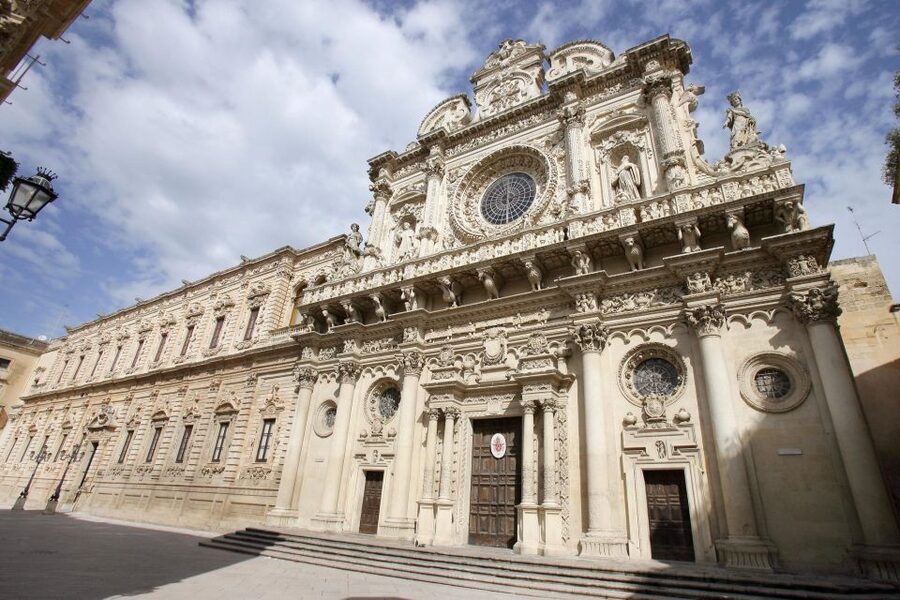
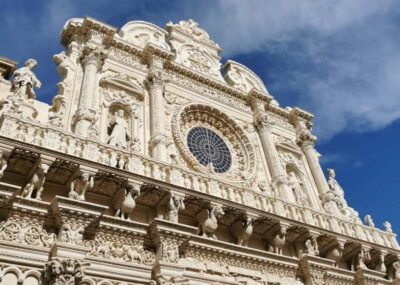
The Basilica of Santa Croce is one of the tour’s most rewarding stops. Its facade is famous for its elaborate carving, but the pleasure is not simply in seeing an ornate church. It is in understanding how the decoration works.
A guide can direct you toward figures, plants, animals, and architectural elements that are difficult to sort out on your own. One guide was specifically praised for explaining the meaning behind the details of the facade. That kind of commentary turns Santa Croce from a quick photo stop into a lesson in how Lecce’s Baroque artists used stone.
The building also shows why this tour is more useful than a general stroll for visitors interested in architecture. You hear about the city’s buildings, monuments, and design, rather than receiving only a list of dates. Fabio Grasso, in particular, is described as having a strong background in architecture and history. Fabrizio is also praised for explaining how the city was developed.
You should keep one limitation in mind: entry tickets for paid churches are not included. The tour takes you to important churches and explains them from the outside, but entering a church that charges admission may require an additional ticket. Ask the guide what is open and included on your chosen date before assuming that every interior visit is covered.
A few more cave trips around Italy worth a look
- Colosseum: Underground and Ancient Rome Tour
★ 4.7 · 12,691 reviews - Rome: Capuchin Crypts and Catacombs Tour with Transfers
★ 4.6 · 6,456 reviews - Expert Guided Tour of Colosseum Arena OR Underground, and Forum
★ 4.5 · 5,041 reviews - The Original Roman Crypts and Catacombs Tour with Transfers
★ 4.5 · 4,896 reviews
Piazza Sant’Oronzo and Lecce’s public face
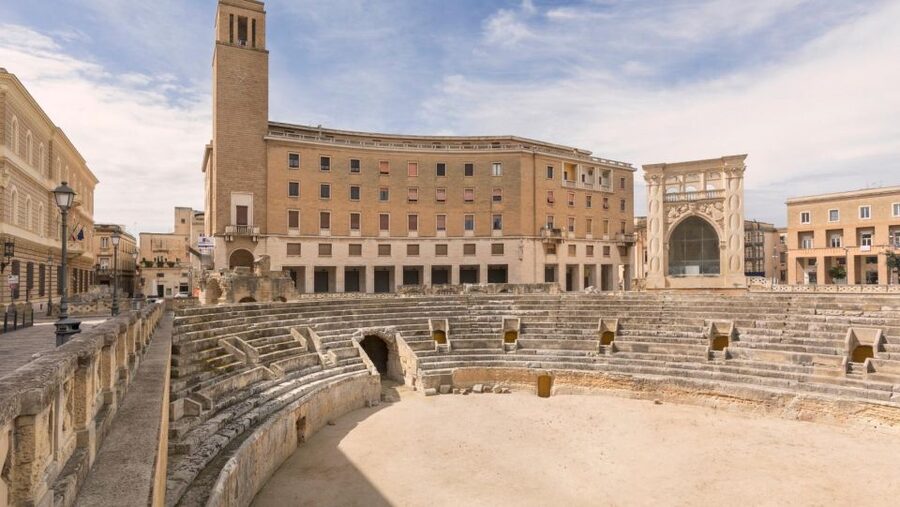
Piazza Sant’Oronzo gives the walk another change of pace. Piazza Duomo feels like a religious setting. Sant’Oronzo is more public and civic, a place where Lecce’s history can be read through monuments, buildings, and the flow of the city around them.
The guide uses the square to connect the old center’s architecture with its wider story. You continue learning how the city’s public spaces were shaped and how different periods left their mark. The value here is not just the square itself, but the way it links the tour’s individual stops.
This is the sort of place where it helps to have a guide who can keep the group together and speak clearly. A group of 10 to 12 people was described as comfortable, while a much larger group could make it harder to hear or see the details being discussed. The guides are generally praised for checking that everyone understands and for keeping the whole group involved.
Do not expect a slow, private architectural consultation. This is a shared walking tour, and the pace must suit several people. You can ask questions, but you may not get unlimited time at every facade. The two-hour format is efficient rather than leisurely.
Faggiano Archaeological Museum and its underground remains
The museum is the tour’s most unusual element. The Faggiano Archaeological Museum occupies a building where excavation work revealed layers from different periods beneath the present structure. The visit gives you a look at artifacts, corridors, chambers, and traces of earlier use.
This changes the tone of the tour. Above ground, Lecce is about visual drama: carved stone, grand churches, and carefully framed squares. Below ground, the focus shifts to evidence of daily life and buried traditions. You are looking at what people left behind, reused, built over, or covered up.
That contrast is the experience’s best idea. The city’s Baroque appearance is only one layer. The museum reminds you that modern Lecce sits on top of older stories. Even a short museum visit can make the streets feel less like a finished display and more like a place built up over centuries.
The underground section should be understood accurately. It is not a lengthy cave tour or a broad network of tunnels beneath the city. The museum reveals archaeological remains under the building, and the tour ends with this visit. One person felt the title suggested more underground exploration than the experience delivered and described the museum as offering only a limited look at the findings.
That criticism is fair, but it does not make the museum unimportant. You should book this tour for a combined city walk and archaeological stop, not for hours below street level. The museum ticket is included, and the guide brings you to it as part of the route.
The guides make the largest difference
The strongest part of this experience is the quality of the guiding. Fabio Grasso appears often in the feedback, with praise for his architectural knowledge, clear English, enthusiasm, and willingness to answer questions. Fabio is also described as an architect and historian, a useful combination for a tour built around buildings.
Elena is praised for her enthusiasm and friendly manner, and one person described a group of 10 to 12 as a good size under her guidance. Ilenia is noted for helping people fall in love with Lecce, while Francesca is described as responsive and engaging. Antonella receives praise for projecting her voice clearly, which is a small detail that becomes very important in a busy square.
Fabrizio is singled out for explaining architectural history and the way Lecce developed. Other guides may lead the tour depending on the date, and the available languages are English and Italian.
The practical lesson is simple: expect a live guide rather than a fixed audio script. That means the tour can feel personal and responsive, but the exact personality and emphasis may vary. The consistent pattern is clear speech, strong knowledge of Lecce, and a willingness to answer questions.
What the $41 price includes
At $41 per person, the tour sits in a reasonable range for a two-hour guided walk with a museum ticket included. The value depends on what you want from Lecce.
If you only want to see the outside of the main monuments, you can walk the center yourself for free. But you will miss the architectural explanations, the connection between the squares, and the museum admission. For a first visit, or for anyone with only a short stay, the guide can help you use two hours well.
The ticket for the Faggiano Archaeological Museum is included. Paid church entry is not, so allow for an extra charge if you decide to enter one of those churches. The tour also includes a guide in English or Italian.
The booking terms are useful for flexible plans. You can reserve now and pay later, and cancellation is free up to 24 hours before the start time. The exact meeting time depends on availability, so check the selected date carefully.
Who should book this tour
I would choose this tour if you are visiting Lecce for the first time, have limited time, or care about architecture but do not want to research every building beforehand. It also suits anyone who likes a mix of famous sights and lesser-known archaeological evidence.
It is a good fit for people who enjoy asking questions. The guides are repeatedly praised for giving the group room to ask, explaining difficult ideas in plain English, and keeping the mood friendly.
You may prefer a different plan if you want to enter many churches, spend a long time in the museum, or explore a large underground network. This is a compact introduction, not a full archaeological day.
Final verdict: a smart first walk through Lecce
Book this tour if you want Lecce to make sense, not just look beautiful. The route covers Piazza Duomo, Corso Vittorio Emanuele, Piazza Sant’Oronzo, Santa Croce, other churches and palaces, and the Faggiano Archaeological Museum. The combination of Baroque architecture above ground and archaeological remains below is genuinely useful.
The main caution is to keep your expectations realistic about the underground portion. It is a museum visit with excavated remains, not an extensive descent beneath the city. If that suits you, the $41 cost is fair, especially with the museum ticket included.
For the best experience, wear good walking shoes, carry water in hot weather, and ask questions. The guide is the heart of the tour, and names such as Fabio Grasso, Elena, Ilenia, Francesca, Antonella, and Fabrizio have been associated with especially strong explanations. For a short stay in Lecce, this is an efficient and worthwhile way to get your bearings.
FAQ
How long does the Lecce guided tour last?
The tour lasts two hours.
What languages are available?
The live guide speaks English or Italian.
Is the Faggiano Archaeological Museum ticket included?
Yes. The ticket for the Faggiano Archaeological Museum is included in the tour price.
Are tickets for paid churches included?
No. Entry tickets for churches that charge admission are not included.
What places are visited during the tour?
The route includes Piazza Duomo, Corso Vittorio Emanuele, Piazza Sant’Oronzo, the Faggiano Archaeological Museum and underground remains, churches, and historic palaces.
Can I cancel the booking for a refund?
Yes. You can cancel up to 24 hours in advance for a full refund. You can also reserve now and pay later.
Just added around Italy
- Boat Tour of the Caves on the Island of Capri★ 4.5 · 463 reviews
- Capri & Blue Grotto: Full-Day Tour with Guided Island Exploration★ 5.0 · 74 reviews
- Private Capri, Anacapri and Blue Grotto Tour from Capri★ 4.5 · 29 reviews
- Paddleboard in Capri between caves and beaches. Photos included!★ 5.0 · 39 reviews
- Private Tour of the Island of Capri by Boat and Visit to the Caves★ 4.5 · 31 reviews
- Blue Grotto and Capri Boat Tour with Aperitivo Swim and Snorkel★ 4.5 · 47 reviews
- Capri Adventure Cruise: Sea Caves, Coastline & Blue Grotto Visit★ 5.0 · 18 reviews
- Small Group Tour to Blue Grotto, Anacapri and Capri★ 5.0 · 115 reviews
Lecce Cave Tours, compared.
Lecce: Baroque Architecture and Underground Walking Tour
Read our review →
Small group tour of the caves of Santa Maria di Leuca
Read our review →
3 Hour Group Tour by Boat to the Caves of Santa Maria di Leuca
Read our review →
Mini-cruise tour to the Caves of Santa Maria di Leuca
Read our review →Browse the lists this tour appears in