
REVIEW · EVENING EXPERIENCES
Meteora Sunset with Monastery & Hermit Caves Tour in Small Group
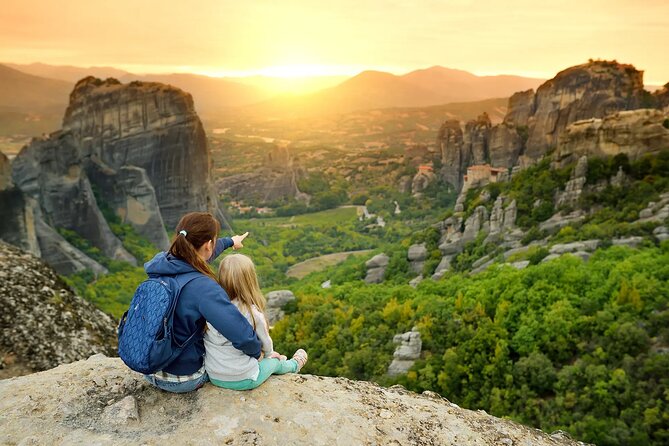
Meteora is at its most dramatic when the sun drops behind its giant rock pillars. This four-hour tour adds the human story behind the cliffs, taking you into Saint Stephen’s Monastery, the Byzantine Church of the Assumption, and old hermit caves before ending at a quiet sunset viewpoint.
I like the easy hotel pickup from Kalambaka or Kastraki, and I like the mix of major sights and less obvious stops. Guides such as Lina, Jim, Maria, Dimitri, and Apostolou are praised for lively storytelling, local knowledge, and help with photos. The main drawback is timing: in June, sunset can push the return well past the advertised four hours.
Key points to know before you book
- Saint Stephen’s Monastery requires no long stair climb, making it the best monastery choice for anyone avoiding steep steps.
- The tour enters one monastery, rather than touring the interiors of several.
- The Byzantine Church contains 11th-century frescoes and pieces of an ancient Greek temple built into its walls.
- The hermit caves add a human side to Meteora, showing where solitary monks lived before organized monasteries grew on the rocks.
- Sunset timing changes with the season, so the tour can run later than four hours in summer.
- Bring cash for entrance fees, since the €7 Meteora admission charge is not included and cards are not accepted at the sites.
Why this sunset tour works well at Meteora
Meteora is not simply a row of monasteries perched on cliffs. It is a small area where towering rock pillars, Orthodox worship, early Christian remains, and centuries of monastic life all occupy the same few square kilometers.
That is why I like this tour’s mix. You do not spend the whole afternoon climbing stairs to look inside one church after another. Instead, you get one accessible monastery, one old church in Kalambaka, the hermit caves, several scenic stops, and a final sunset.
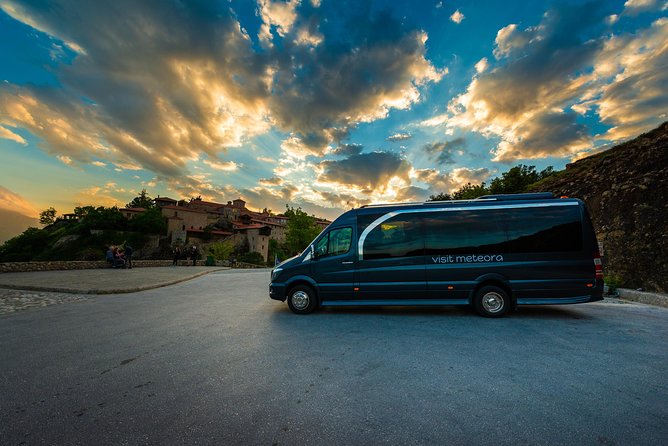
The small-group minibus matters here. With a maximum of 18 people, you get a more personal setting than a large coach tour, while still avoiding the work of arranging every viewpoint and road connection yourself. Hotel or apartment pickup is available in Kalambaka and Kastraki, and the tour returns to the starting point.
The price is about $36.28 per person, before the separate €7 Meteora admission charge. That is good value if you want transport, an English-speaking guide, bottled water, and access to several places in one afternoon. It is less attractive if your main goal is to enter many monasteries, since this outing includes the interior of Saint Stephen’s only.
More Evening Trips in Greece:
- Portimão: Benagil Caves Speed Boat Tour with Sunset Option
★ 4.8 · 11,663 reviews - Edinburgh: Late-Night Underground Vaults Terror Tour
★ 4.6 · 4,162 reviews - Edinburgh: Evening Underground Ghost Tour
★ 4.4 · 3,092 reviews
The opening ride through Meteora’s rock pillars
The tour begins at Patriarchou Dimitriou 2 in Kalambaka, with pickup also offered from hotels and Airbnbs in Kalambaka and Kastraki. The first part helps you understand the setting before you reach the religious sites.
Meteora lies at the northwest edge of the Thessalian plain. Its enormous pillars rise above the two settlements, Kalambaka and Kastraki, and the whole area is protected as a UNESCO World Heritage Site, an archaeological site, and an officially declared holy place.
Your guide adds the context that is easy to miss when driving around on your own. The story is not only about spectacular geology. It is also about hermits seeking solitude, monks building communities in difficult places, and monasteries surviving changes in Greek history.
Guides vary by departure, but names praised for clear explanations and good stories include Lina, Jim, Maria, Dimitri, Apostolou, and Demetrios. Their approach appears to be conversational rather than a nonstop list of dates. That suits Meteora, where the cliffs are impressive enough and the human details give them meaning.
The Byzantine Church and its unusual walls
The Byzantine Church of the Assumption of the Virgin Mary is in Kalambaka, and the visit lasts about 30 minutes. The admission fee is separate, so keep cash ready.
The church is special for several reasons. Its frescoes include precious 11th-century Byzantine work, and its walls contain stones taken from an ancient Greek temple dedicated to Apollo. You can also see parts of an older mosaic floor beneath the current floor in selected places.
This is a compact stop, but it gives you a close look at religious art and construction details that are easy to miss from a minibus window. The church remains active for local worship, which adds a living quality to the visit.
The main caution is pace. One participant found the church stop too long, while others appreciated the detailed explanation. If you prefer quick photo stops, this may feel slow. If you want to understand the layers of Meteora’s past, the half-hour is useful.
Entering Saint Stephen’s without a staircase climb
Saint Stephen’s is the one monastery you visit inside on this tour. It is also the easiest monastery in Meteora to reach, since the entrance is reached by crossing a small bridge rather than climbing a long flight of steps.
That makes the stop especially useful if stairs are a concern, though you should still be comfortable walking across the site and standing during the visit. The monastery’s monastic story reaches back to the early 12th century. Hosios Antonios and Hosios Philotheos are linked with its early development, and Philotheos rebuilt the small catholicon in 1545.
The interior gives you the actual monastery experience that a viewpoint cannot provide. You see a place of worship, not just a building on a rock. The setting also helps you appreciate how unusual it was to build and maintain religious communities in these locations.
Dress properly. Men need trousers and long sleeves. Women need a long skirt. If you arrive in shorts, trousers and skirts are provided, but it is simpler to wear suitable clothing from the start.
Saint Stephen’s is closed on Mondays. On that day, the tour visits Saint Nicholas or Roussanou instead. If entering Saint Stephen’s is central to your plans, avoid Monday or confirm the replacement before booking.
A few more cave trips around Greece worth a look
- From Corfu: Day Cruise to Paxos, Antipaxos, & the Blue Caves
★ 4.3 · 4,800 reviews - Athens: Meteora Monasteries Day Trip with Caves and Lunch
★ 4.7 · 4,670 reviews - From Corfu Island: Antipaxos & Paxos Blue Caves Boat Cruise
★ 4.7 · 3,690 reviews - Zakinthos: Shipwreck Beach and Blue Caves Land and Sea Tour
★ 4.6 · 3,359 reviews
Hermit caves and the first monastic life
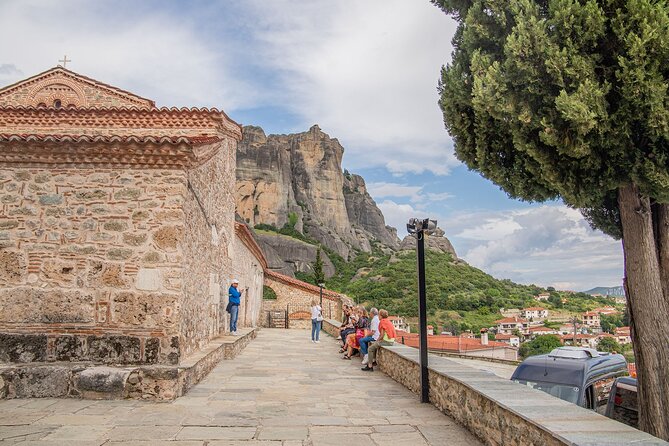
The hermit caves are one of the most distinctive parts of the outing. Before organized monasteries took shape, solitary monks lived in small caves and shelters cut into or tucked beside the rocks.
The visit helps you picture an earlier, far less comfortable form of religious life. You are not just looking at grand churches and painted walls. You are seeing the rough spaces where individuals chose isolation, prayer, and hard physical conditions.
This is also where a good guide earns the fare. Guides explain how the caves fit into the later growth of the monasteries and how monks and nuns lived in the area over time. Stories about daily life can make these openings in the rock more memorable than another formal church interior.
The caves are not presented as a long hiking route in the tour description. Still, wear sensible shoes and expect some walking at stops. The attraction here is the setting and the story, not a polished visitor facility.
Views of Great Meteoron, Roussanou, and Varlaam
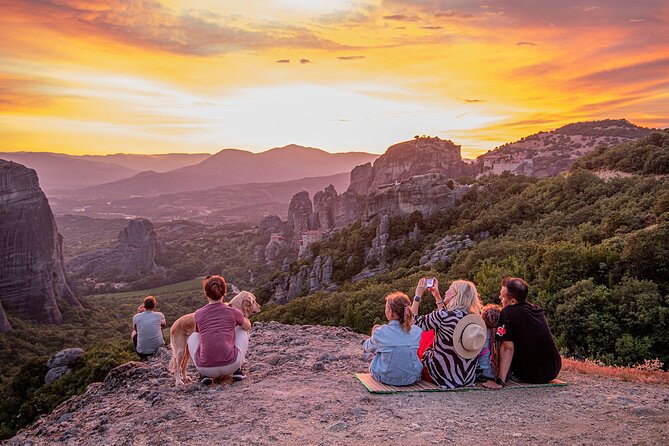
The route also takes you past the major monasteries and viewpoints. The Great Meteoron is the largest and oldest monastery in Meteora. Its name refers to the idea of being suspended in the air, a fitting description for a monastery placed on top of one of the giant pillars.
Saint Athanasios the Meteorite founded the Great Meteoron and organized a systematic monastic community there. That development marked an important change from scattered hermit life to organized monasticism in Holy Meteora.
Varlaam, the second-largest monastery, sits opposite Great Meteoron. It was founded in the mid-14th century by Hosios Varlaam. Its main church, built in the 1540s by Hosioi Theophanes and Nectarios Apsarades, contains wall paintings attributed to the hagiographer Frago Catelano of Thebes.
Roussanou occupies a lower rock and is more accessible than monasteries built higher up. It took its name from an early hermit associated with the rock. The main church dates from the end of the 16th century, and the site became a convent in 1988 after severe wartime damage and later changes.
You generally view these monasteries from outside on this tour rather than entering each one. That is an important distinction. The route gives you their shapes, settings, and history, while a separate monastery visit on another day would be better if you want to see several interiors.
The final sunset viewpoint
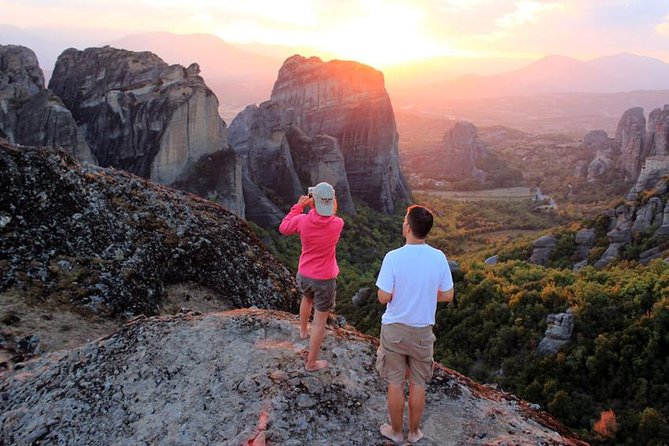
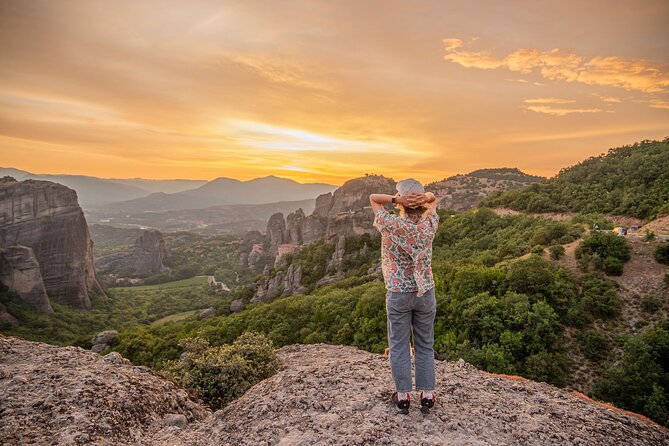
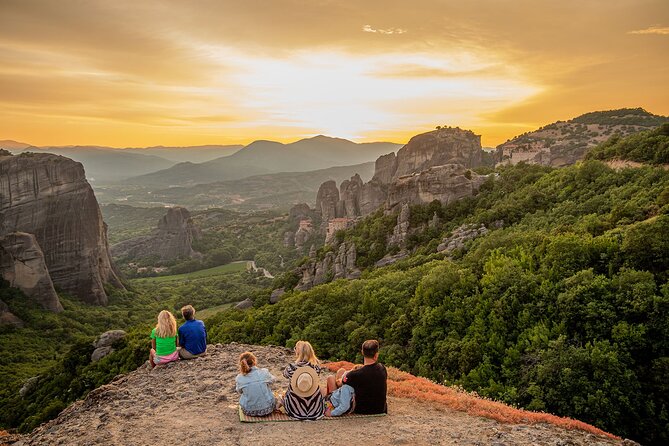
The last stop is a lesser-known rock viewpoint chosen for sunset. It is the moment that gives the tour its name, and it is also the part most affected by the calendar and weather.
Sunset arrives early in winter and much later in June. Around the longest days of the year, you may not return until roughly 9:30 in the evening, even though the advertised duration is about four hours. The tour follows the light, so the exact finish cannot be fixed in the same way as a morning museum visit.
This late timing can be a problem if you have a train, dinner reservation, or evening transfer. Build in extra room. On the other hand, the reward is a changing view over the rock pillars, monasteries, and plain. Clouds can make the scene better rather than worse, with breaks of light and stronger colors near sunset.
You may find the viewpoint less crowded than the major daytime stops, though crowd levels and weather vary. Bring a layer, especially outside summer. One participant found the evening cold, and the open rock can feel cooler than the town.
What the guide and minibus add
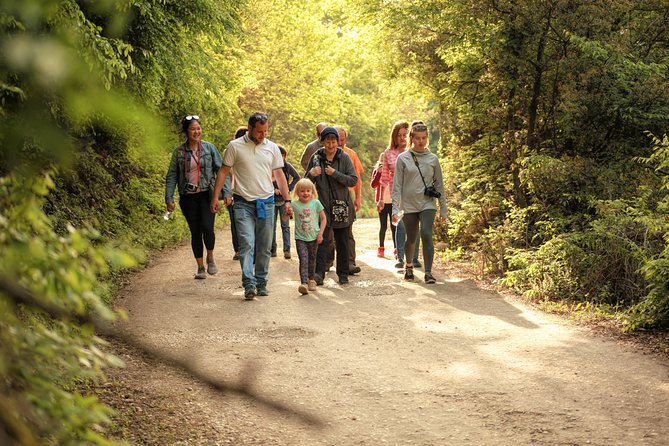
The minibus keeps the day simple. You are picked up in Kalambaka or Kastraki, driven between the scattered sites, and returned to the starting point. Bottled water is included, while food and drinks are not.
The driving is only part of the value. A guide can point out the difference between a monastery built for a community and a cave used by a solitary hermit. You also get stories about the Byzantine and Ottoman periods, World War II damage, and postwar rebuilding, details that are easy to miss when visiting independently.
The guides are also helpful with photos. Jim, Lina, Maria, Dimitri, and other named guides have been praised for choosing good photo points, explaining the views, and keeping the tone relaxed. Guide quality can vary by departure, but the strongest pattern is clear storytelling rather than formal lecture delivery.
The tour is guided in English. Free audio guides are available through a smart app in Spanish, French, German, Italian, Portuguese, Russian, Polish, Korean, Chinese, and Japanese. The audio option is useful, but it will not provide the same back-and-forth detail as the live English commentary.
Timing, clothing, cash, and access
The tour is suitable for most people, and Saint Stephen’s avoids the long stair climb found at some other monasteries. It is not presented as a demanding hike, but you should expect walking at the church, monastery, caves, and viewpoints.
The monastery dress code is strict. Men need long trousers and long sleeves. Women need a long skirt. Covering garments are available if needed, but planning ahead saves time.
The listed Meteora admission fee is €7 per booking and is not included in the tour price. Carry cash because cards are not accepted at the sites. Food and drinks are also separate, so eat before departure or plan for your own supplies.
The activity is subject to good weather and a minimum group size. If poor weather or low enrollment cancels the outing, you are offered another date, another experience, or a full refund. Free cancellation is available up to 24 hours before the start time.
Who should book this Meteora experience?
I would choose this tour if you have only one afternoon in Meteora, arrive later in the day, or want a guide to handle the roads and viewpoints. It is also a strong choice if you want more than the standard monastery circuit, especially the hermit caves and the Byzantine Church.
It suits anyone who prefers a balanced outing rather than repeated stair climbs. Saint Stephen’s is accessible, and the route includes scenic stops without requiring you to enter every monastery.
I would choose something else if your priority is visiting several monastery interiors. This tour enters one monastery, and the other major sites are mainly viewed from outside. I would also avoid booking it on a tight evening schedule, particularly in June, when sunset comes late.
Should you book it?
Book this tour if you want Meteora explained as a place of geology, faith, and human endurance, not just photographed from a road. At about $36.28 per person, the transport, guide, church, monastery, caves, and sunset make a solid package, with the €7 admission fee added separately.
Plan for proper clothing, cash, sensible shoes, and a late return in summer. If you do that, this is an efficient first look at Meteora and a useful introduction before visiting more monasteries on your own the next day.
FAQ
How long does the Meteora sunset tour last?
The advertised duration is approximately four hours, but the actual finish depends on the season and sunset time. In June, the tour can return around 9:30 p.m.
Where does the tour begin?
The meeting point is Patriarchou Dimitriou 2 in Kalambaka. Pickup and drop-off are also offered at hotels and Airbnbs in Kalambaka and Kastraki.
Which monastery do you visit inside?
The standard visit inside is Saint Stephen’s Monastery. It is reached by crossing a small bridge rather than climbing a long staircase.
Is Saint Stephen’s Monastery open every day?
Saint Stephen’s is closed on Mondays. On Mondays, the tour visits Saint Nicholas Monastery or Roussanou Monastery instead.
Does the tour enter the Great Meteoron, Roussanou, and Varlaam monasteries?
The tour includes information and views of these monasteries, but the included interior monastery visit is Saint Stephen’s.
What languages are available?
The live tour is guided in English. Free audio guides are available in Spanish, French, German, Italian, Portuguese, Russian, Polish, Korean, Chinese, and Japanese.
What should I wear to the monasteries?
Men must wear trousers and long sleeves. Women must wear a long skirt. Trousers and skirts are provided if you arrive in clothing that does not meet the dress code.
Is the entrance fee included?
No. A €7 Meteora admission fee is listed separately from the tour price. Bring cash because cards are not accepted at the sites.
Just added around Greece
- From Faliraki : Speedboat tour kalithea caves&antony kouin★ 5.0 · 25 reviews
- From Argostoli: Melissani Lake and Myrtos Beach Tour★ 4.7 · 150 reviews
- From Ag Anna: Rina’s Cave and Ano and Kato Koufonisi Cruise★ 4.2 · 504 reviews
- Faliraki: Boat Trip to Anthony Quinn & The Caves with Drinks★ 4.8 · 386 reviews
- Faliraki: Boat Trip to Afandou Caves, Anthony Quinn & Ladiko★ 4.8 · 139 reviews
- From Lefkimmi: Paxos, Antipaxos & Blue Caves Boat Tour★ 4.2 · 62 reviews
- FALIRAKI: BOAT TRIP TO ANTONY QUINN, LADIKO, AFANDOU CAVES★ 4.9 · 56 reviews
- From Naxos: Koufonisia Boat Cruise and Rina’s Cave w/ Lunch★ 4.3 · 101 reviews
Evening Experiences, compared.
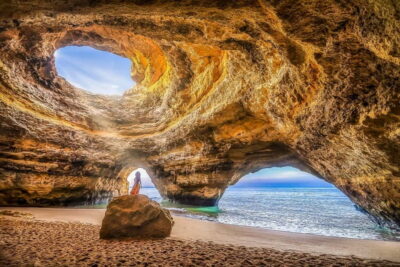
Portimão: Benagil Caves Speed Boat Tour with Sunset Option
Read our review →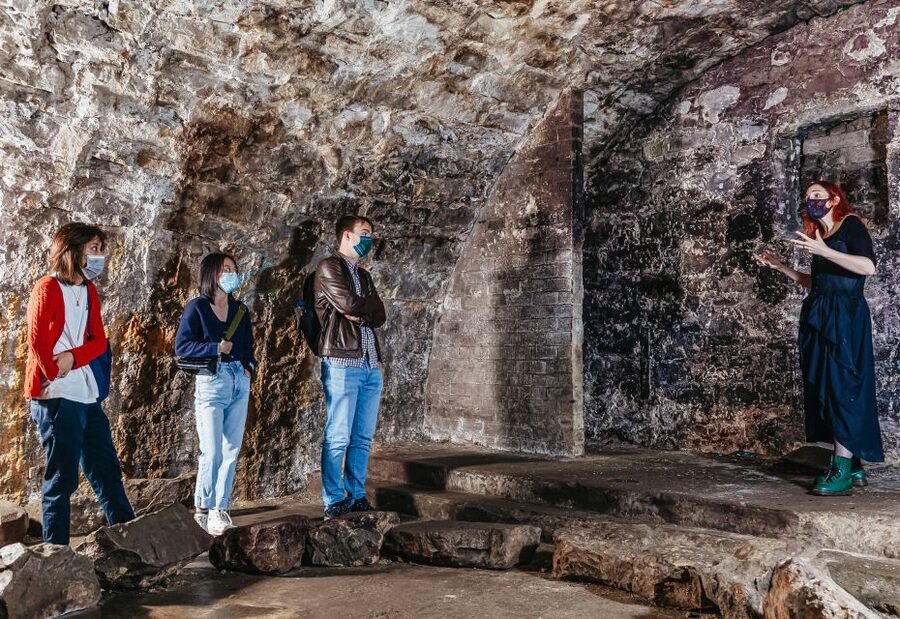
Edinburgh: Late-Night Underground Vaults Terror Tour
Read our review →
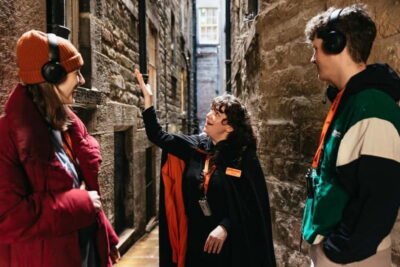
Edinburgh: Underground Vaults Evening Ghost Tour with Whisky
Read our review →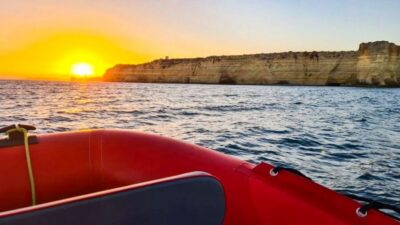
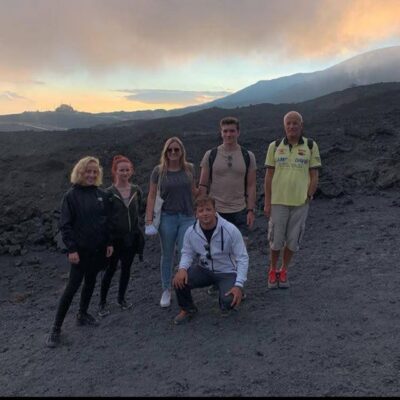
Catania: Sunset Jeep Tour of Mount Etna and Lava Flow Caves
Read our review →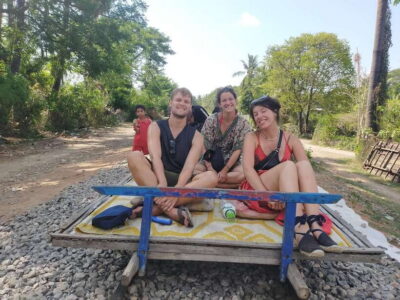
Battambang: Tuk-Tuk, Bamboo Train, Killing/Bat Caves, Sunset
Read our review →
Etna Sunset Tour: Volcano trek, Cave & tasting from Catania
Read our review →Browse the lists this tour appears in