
REVIEW · EVENING EXPERIENCES
Meteora: Sunset Small Size Tour with Monasteries & Caves
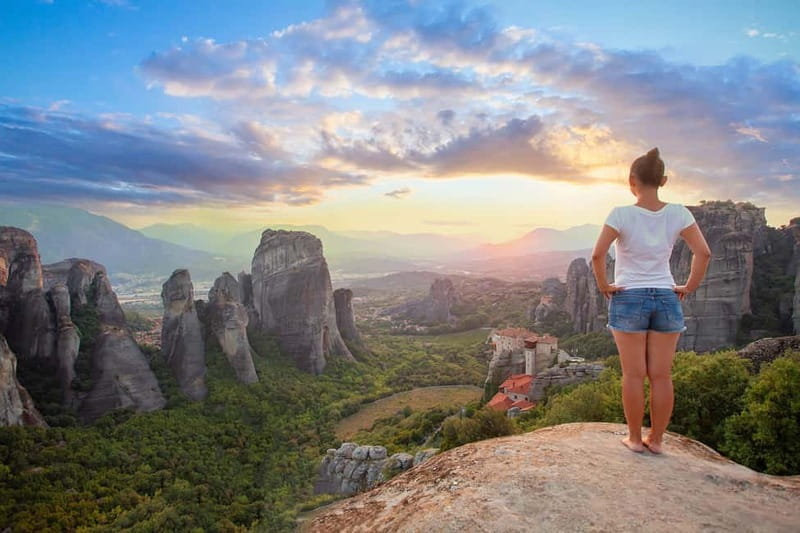
Meteora saves one of its best scenes for last: as the sun drops behind the strange stone pillars, the monasteries seem to hover above the valley. This tour gets you there after the daytime crowds have thinned, while also fitting in all six monasteries, Bandovas hermit caves, and an old Byzantine church.
I like the local feel, especially when guides such as Lina, Jim, Demetris, or Vasiliki explain how people in Kalabaka lived alongside the monks. I also like the easy hotel pickup, air-conditioned minibus, free water, and many chances to stop for photos.
The main catch is simple: this is a late-afternoon tour, so only one monastery is normally open for an inside visit. You see the other five from outside, and the €5 monastery fee plus €2 church fee are not included.
Key points at a glance
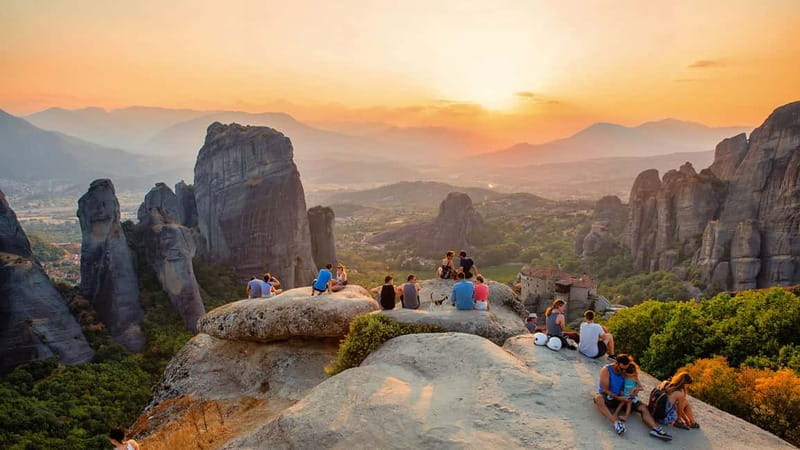
- One monastery interior: Spend about 45 minutes inside the selected open monastery, often St. Stephen, with time to see its rooms, chapel, and views.
- All six monasteries: Get an exterior view of Holy Trinity, St. Stephen, St. Nicholas Anapavsa, Great Meteor, Varlaam, and Rousanou.
- Bandovas hermit caves: Walk to old cliffside hermitages where monks lived in caves centuries ago.
- Kalabaka’s ancient church: Visit the Byzantine Church of the Virgin Mary, built on the site of an ancient temple dedicated to Apollo.
- Sunset finale: Finish at a carefully chosen viewpoint with broad views of the rock formations.
- Small-group comfort: Travel by air-conditioned minibus with pickup and drop-off in Kalabaka, Kastraki, or nearby accommodation.
Why the late-afternoon timing works so well
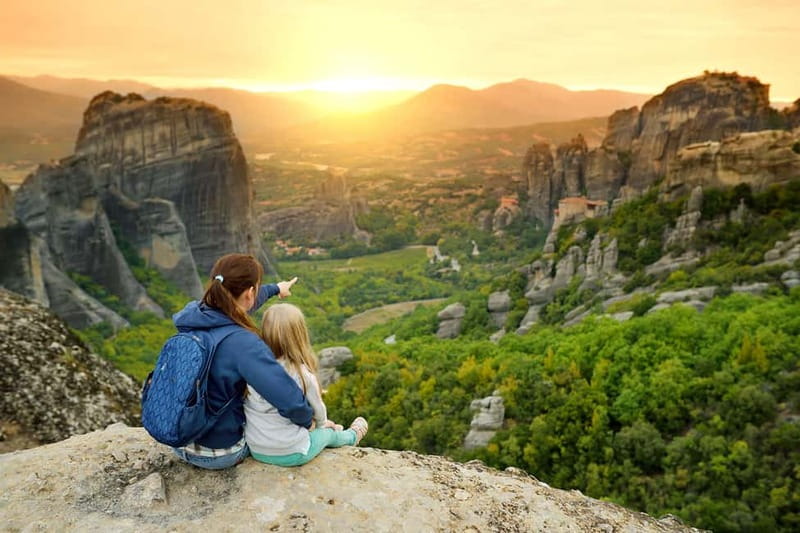
Meteora is at its busiest during the morning and early afternoon. Tour buses arrive, monastery entrances fill, and the narrow roads can feel crowded. This 270-minute outing starts later, after many visitors have returned to their hotels.
That timing changes the mood. You get softer light on the cliffs, fewer people at some viewpoints, and a quieter ride through Kastraki and the mountain roads. I especially like the way the tour builds toward sunset rather than treating it as an afterthought.
The tour is not simply a ride to one lookout. You move through the area’s religious, geological, and local history. The guide explains why monks chose these high rocks, how the monasteries were built, and what daily life looked like for people who lived in caves or behind monastery walls.
The English-speaking guide leads the main commentary. A free audio guide is also available in English, Spanish, French, German, Italian, Portuguese, Polish, Russian, Chinese, Korean, and Japanese. Download or arrange access before leaving if you need another language. One French-speaking family found that weak internet made it difficult to get the audio working on the road.
More Evening Trips in Greece:
- Meteora Sunset with Monastery & Hermit Caves Tour in Small Group
★ 5.0 · 706 reviews - Meteora: Guided Sunset Tour with Monasteries & Caves Visit
★ 4.7 · 409 reviews - From Lefkimmi: Syvota, Blue Lagoon and Cave Sunset Cruise
★ 4.7 · 332 reviews
Pickup in Kalabaka or Kastraki, then up into the rocks
Pickup is offered from hotels, villas, guesthouses, Airbnbs, and camping sites in Kalabaka and Kastraki. The tour can also use meeting points in those towns and Trikala, with drop-off available in Kalabaka, Kastraki, or Trikala.
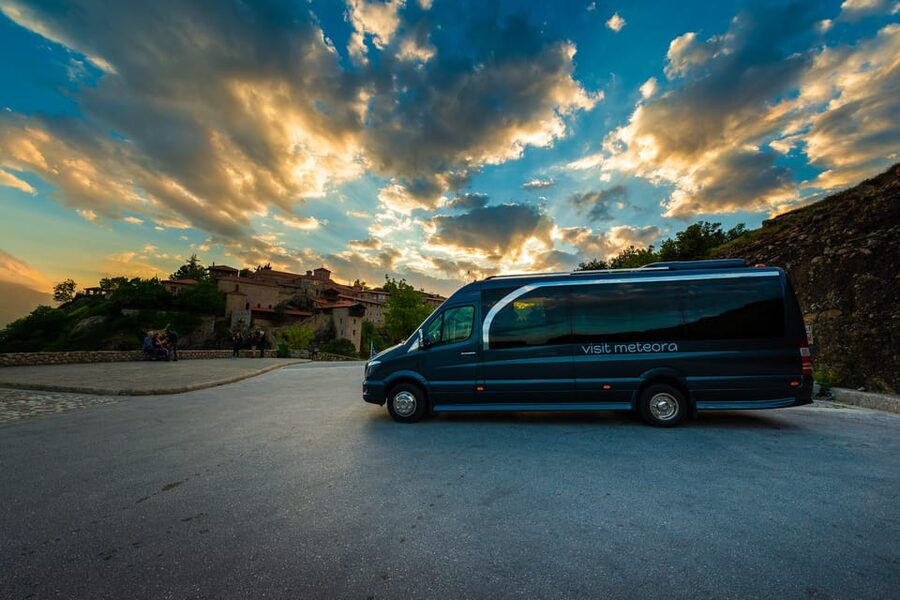
The vehicle is an air-conditioned minibus. That matters in the hot months, when the exposed rock and monastery steps can make even short walks tiring. Most reports describe the ride as comfortable, though one summer outing had weaker air conditioning than expected.
The route includes several short drives between stops. You are not stuck on the bus for hours, but you should expect a fairly active sightseeing loop, with repeated climbs in and out of the vehicle and short walks on uneven paths.
Kastraki gives you the first sense of scale
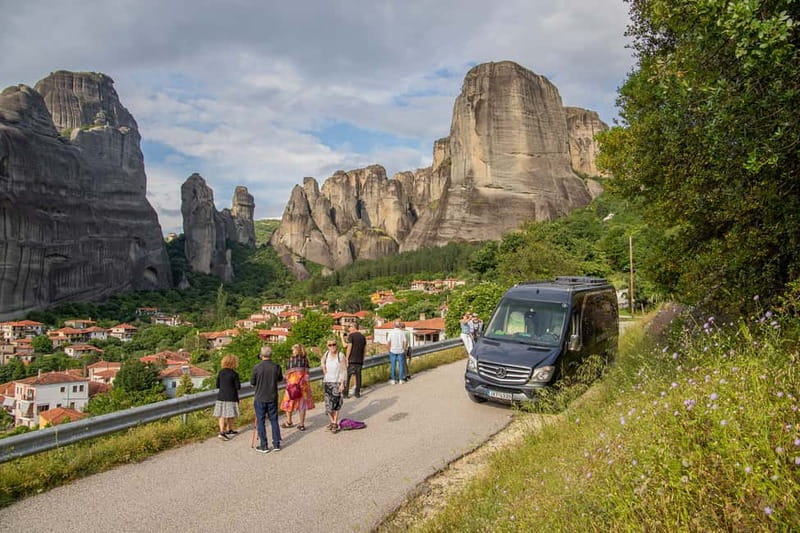
The first stop is Kastraki, a village beneath the rock towers. You have about 15 minutes for photos and a look around.
This is a useful opening stop because it lets you see how closely the village sits beneath the cliffs. The rocks are not distant mountains. They rise sharply behind homes and roads, making the setting feel almost theatrical without needing any special viewpoint.
Use this time to take a few broad photos rather than trying to capture every detail. You will have many more photo stops later, and the guide can help with group pictures. Several guides, including Jim and Lina, are praised for taking photos for people who want them.
Holy Trinity and the first monastery views
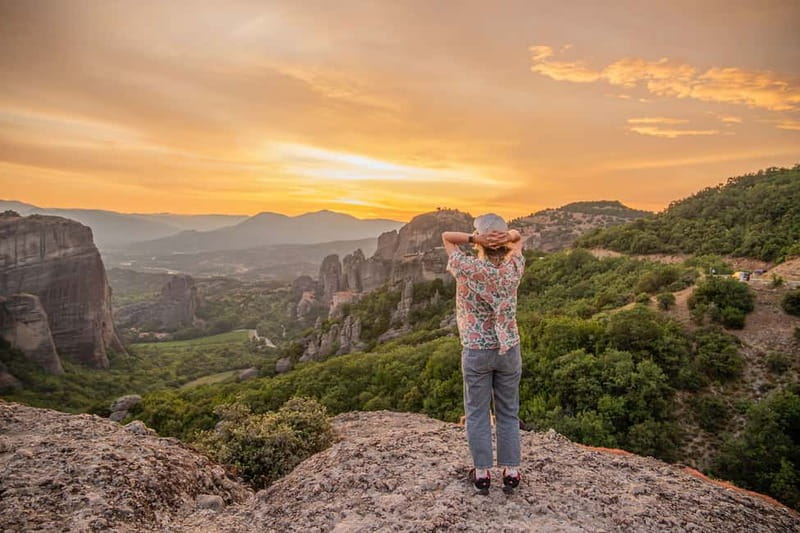
The route then reaches the area around Holy Trinity Monastery. The stop is short, about 15 minutes, so this is mainly an outside viewing and photo stop rather than a full visit inside.
Holy Trinity is one of Meteora’s most dramatic monasteries, perched high above the valley. Even when you do not climb to the entrance, the view helps explain the basic question every visitor has: why build a monastery up there?
The guide fills in the practical story. These sites offered isolation, protection, and a place for religious life away from ordinary settlement. You also get a sense of the physical effort involved in reaching and maintaining them.
A few more cave trips around Greece worth a look
- From Corfu: Day Cruise to Paxos, Antipaxos, & the Blue Caves
★ 4.3 · 4,800 reviews - Athens: Meteora Monasteries Day Trip with Caves and Lunch
★ 4.7 · 4,670 reviews - From Corfu Island: Antipaxos & Paxos Blue Caves Boat Cruise
★ 4.7 · 3,690 reviews - Zakinthos: Shipwreck Beach and Blue Caves Land and Sea Tour
★ 4.6 · 3,359 reviews
St. Stephen offers the main monastery visit
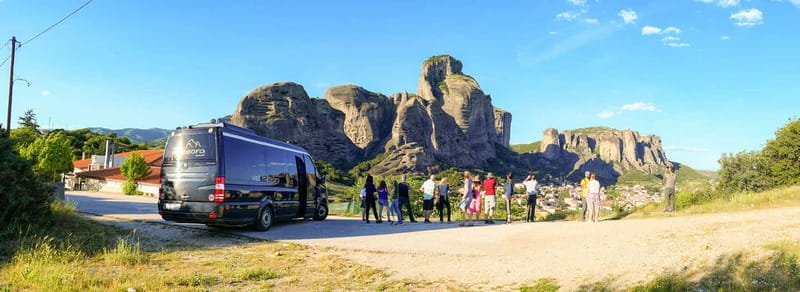
The longest stop is at St. Stephen’s Monastery, with roughly 45 minutes for a visit and free time. Since this is a late-day tour, St. Stephen is commonly the monastery selected for interior access, though opening schedules can change.
This is the point where the tour shifts from viewing Meteora to entering it. You can see the working character of an active religious site, including its chapel, religious art, and views from the monastery grounds. The guide or driver does not accompany you inside, so the visit is semi-independent.
That arrangement is worth understanding before you book. You receive background information outside, then explore the interior on your own rather than following a licensed guide through every room. The free audio guide can add context at the monastery and at more than 20 points of interest.
The monastery has a strict dress code. Men need long trousers and covered shoulders. Women should bring a scarf or shawl and clothing that can be covered with a skirt if needed. Women can borrow or buy covering garments at the entrance, but I would still bring a scarf and avoid shorts or sleeveless tops from the start.
The entry fee is €5 per person and is paid separately. Bring cash.
St. Nicholas Anapavsa shows a different side of Meteora
The next stop is St. Nicholas Anapavsa, where you get another exterior view and about 15 minutes of explanation.
Its position on a smaller rock makes it feel more compact than the large monastery complexes. The stop is useful because Meteora is not one repeated postcard. Each monastery has a different setting, approach, and silhouette.
You will not have time to explore every monastery inside on this excursion. That is the tradeoff for seeing all six and reaching the sunset viewpoint in one afternoon. If entering several monasteries is your main goal, plan a separate daytime visit.
Kalabaka’s Byzantine Church connects ancient and modern history
The tour returns briefly toward Kalabaka for the Byzantine Church of the Virgin Mary. You have about 15 minutes for a guided visit and photos, with a €2 entry fee paid separately.
This is one of the most worthwhile stops for anyone who wants more than dramatic views. The church is associated with an earlier temple dedicated to Apollo, and its painted interior and layout help connect the area’s ancient, Byzantine, and Orthodox traditions.
The church visit also gives the tour a welcome change of pace. After the towering cliffs and monastery exteriors, you step into a smaller, human-scale place of worship. Guides have explained the arrangement of the church, the meaning of the paintings, and the role of the building in local life.
I would bring cash for this fee and dress respectfully. The tour information specifically asks you to bring comfortable shoes, a camera, cash, and a scarf.
Bandovas hermit caves are the most unusual stop
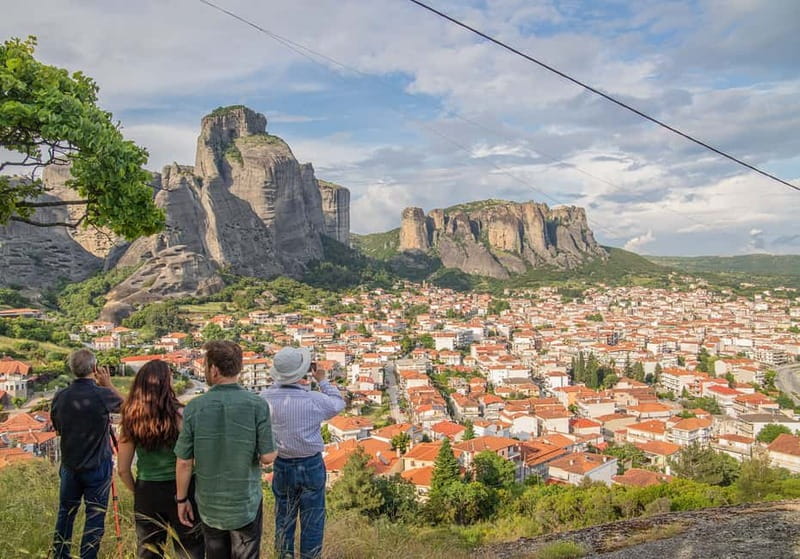
The visit to the Bandovas hermit caves takes about 35 minutes and includes a guided walk. These are old cave hermitages high in the rocks, where ascetic monks lived roughly two centuries ago, with the wider tradition reaching back much further.
This stop adds something you cannot get from a standard monastery circuit. The large monasteries show organized religious communities, while the caves show the harsher, more solitary side of monastic life.
You walk along paths and look toward openings in the rock where hermits lived and prayed. The guide explains how these early religious figures used the cliffs and how local people interacted with the monks over time.
Wear real walking shoes. The tour is not presented as a strenuous hike, but the cave area is not a polished indoor attraction. Uneven ground, steps, and short uphill sections are part of the experience.
Great Meteor and Varlaam complete the monastery circuit
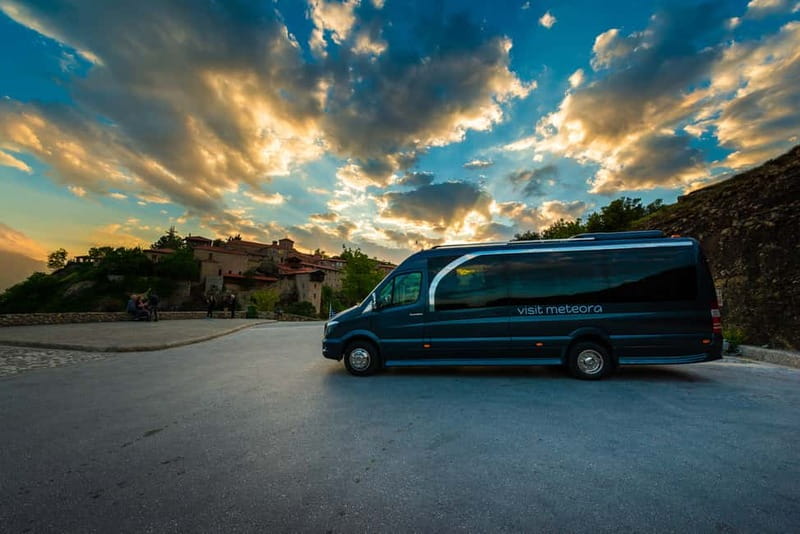
After the church and caves, the minibus returns to the high road for views of Great Meteor Monastery and Varlaam Monastery. Each stop is about 15 minutes, mainly for outside viewing, explanations, and photos.
Great Meteor is the largest and highest of the monasteries. Even from outside, its size and position help you understand why it became the central site in the Meteora group.
Varlaam gives you another impressive angle across the rocks. The guide points out the buildings, access routes, and surrounding cliffs while you take photos. These stops are brief, so listen during the drive as well as at the viewpoints. The commentary continues as the minibus moves between sites.
The route is carefully timed around the changing light. You do not linger at every monastery, but you see all six: Holy Trinity, St. Stephen, St. Nicholas Anapavsa, Great Meteor, Varlaam, and Rousanou.
The sunset viewpoint is the payoff
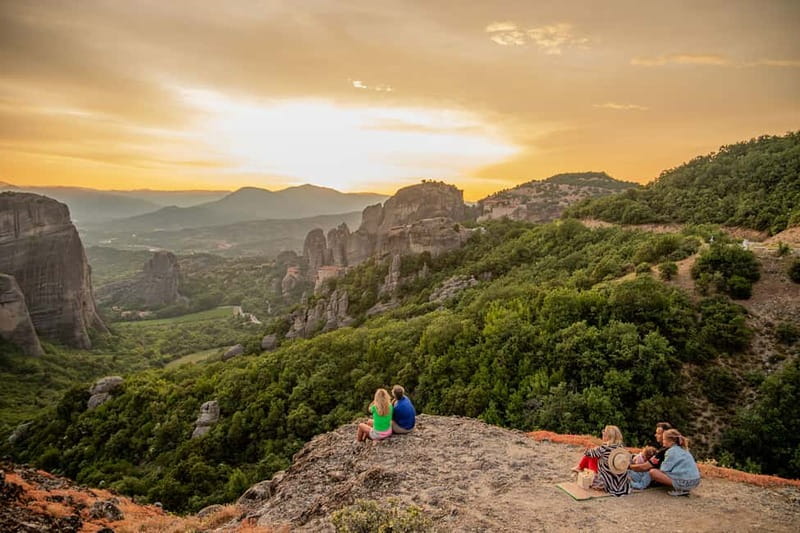
Near the end, the tour stops at a broad viewpoint for about 10 minutes, then continues toward Rousanou and the final sunset stop. The exact light depends on the season and weather, but the goal is to reach the best viewing area as the sun begins to drop.
This is where the tour earns its name. The rock pillars take on warmer color, shadows stretch across the valley, and the monasteries become small, bright shapes against the cliffs.
Bring your camera, but do not spend the whole time looking at the screen. The guides usually allow enough time for photos and help with group shots. If clouds block the sun, the view remains impressive, but you should not treat a clear sunset as guaranteed. Several outings had cloudy or foggy conditions and still delivered strong scenery, but weather can change the final effect.
The route includes Rousanou as the last monastery stop, with time for photos, a short walk, and sunset views. Rousanou’s position makes it especially good for seeing how the monasteries relate to one another across the rocks.
Guide quality makes a real difference
This tour depends heavily on the person leading it. The best guides bring local knowledge and explain more than dates and names.
Jim, also called Dimitris, has been praised for connecting monastery history with stories about local families and everyday life. Lina and Vasiliki have an archaeology background and are especially strong at explaining art, churches, and religious customs. Demetris has been described as lively and clear, while Andreas, Tolis, Vasilly, Vaggelis, and Apostolis have also led memorable outings.
The guide speaks English, with Greek also listed as an available language. The main tour is not multilingual in person, so non-English speakers should rely on the audio guide. The audio option covers many languages, but you should sort out the download before pickup rather than wait for a strong connection on the mountain.
The guide and driver do not enter the monasteries with you. That is normal for this format, but it means you should listen carefully to the outside explanations and use the audio guide inside.
What the $35 price really buys you
At $35 per person, this is a strong value if you want broad coverage and sunset without arranging a car. The fee includes hotel pickup and drop-off, the minibus, a local English-speaking guide, water, scenic stops at all six monasteries, the cave visit, and the interior visit to one monastery.
You still pay €5 for monastery entry and €2 for the Byzantine church. Food is not included, so eat before departure or carry a small snack. One outing included a stop at a family-owned shop or restaurant, but that should not be treated as a guaranteed meal stop.
The value is less obvious if your priority is entering several monasteries. In that case, a daytime visit gives you more access, while this tour gives you atmosphere, local stories, caves, and sunset.
Who should book it
I would choose this for a first visit to Meteora, especially if you have only one afternoon. It covers the major views without making you plan a complicated route, and it adds places that are easy to miss on a self-guided drive.
Families can also do well here. The stops provide regular chances to stretch your legs, and guides have kept young children involved with stories and questions. Still, babies under one year are not accepted, and the tour is not suitable for wheelchair users.
This is also a good fit for photographers, casual sightseers, and anyone who wants the monasteries explained rather than simply photographed. It is less suitable if you need a fully guided monastery interior visit, dislike uneven walking, or want a guaranteed clear sunset.
Cancellation is free up to 24 hours before departure, and you can reserve now and pay later. Pickup is available from accommodation in Kalabaka and Kastraki, making the tour especially convenient if you are staying in either town.
Final call: book for the full Meteora picture
Book this tour if you want a well-priced introduction that combines one monastery interior, all six monastery views, ancient church art, hermit caves, and sunset in one afternoon.
Skip it only if you plan to spend a full day visiting monastery interiors one by one. For most first-time visitors, the late light, local storytelling, comfortable transport, and Bandovas cave walk make this a satisfying way to see why Meteora is more than a collection of famous buildings on rocks.
FAQ
How long does the Meteora sunset tour last?
The tour lasts 270 minutes, or 4 hours and 30 minutes.
Which monasteries can I see?
You see Holy Trinity, St. Stephen, St. Nicholas Anapavsa, Great Meteor, Varlaam, and Rousanou from scenic stops and viewpoints.
Can I go inside all six monasteries?
No. The late-afternoon schedule normally allows an interior visit to one selected monastery. The other monasteries are viewed from outside.
How much are the entrance fees?
The monastery entry fee is €5 per person, and the Byzantine Church of the Virgin Mary entry fee is €2 per person. These fees are not included in the tour price.
Is the tour available in languages other than English?
The live guide speaks English and Greek. A free audio guide is available in Spanish, French, German, Italian, Portuguese, Polish, Russian, Chinese, Korean, Japanese, and English.
What should I wear?
Wear comfortable shoes and bring a scarf. Men cannot enter the monasteries in shorts or sleeveless clothing. Women need to follow the monastery dress code and may borrow or buy covering garments at the entrance.
Where can I be picked up and dropped off?
Pickup and drop-off are available from accommodation and selected locations in Kalabaka, Kastraki, and Trikala.
Just added around Greece
- Pelion Boat Trip to “Poseidon’s Caves”★ 5.0 · 149 reviews
- PRIVATE-Knossos Palace-Zeus Cave-Olive Oil Tasting-Old Villages★ 5.0 · 81 reviews
- Knossos & lasithi plateau villages,Zeus’s cave,&olive oil Mill★ 5.0 · 90 reviews
- Heraklion Highlights: Knossos, Museum & Historic City Drive★ 5.0 · 64 reviews
- Knossos-Lasithi Plateau-Cave of Zeus for Cruises Heraklion Port★ 5.0 · 26 reviews
- PRIVATE-Zeus Cave-Knossos-Olive oil Factory-Traditional Villages.★ 5.0 · 69 reviews
- Knossos Cave of Zeus and Olive Oil Factory Full Day Private Tour★ 5.0 · 19 reviews
- Paxoi, Antipaxoi and Blue Caves Cruise from Corfu★ 4.0 · 159 reviews
Evening Experiences, compared.
Portimão: Benagil Caves Speed Boat Tour with Sunset Option
Read our review →
Edinburgh: Late-Night Underground Vaults Terror Tour
Read our review →
Edinburgh: Underground Vaults Evening Ghost Tour with Whisky
Read our review →
Catania: Sunset Jeep Tour of Mount Etna and Lava Flow Caves
Read our review →
Battambang: Tuk-Tuk, Bamboo Train, Killing/Bat Caves, Sunset
Read our review →
Etna Sunset Tour: Volcano trek, Cave & tasting from Catania
Read our review →Browse the lists this tour appears in