REVIEW · ROME
Rome Underground: Catacombs Tour, Aqueducts and Appian Way
Rome’s most memorable ancient sights are not all inside the Colosseum or Forum. This half-day outing takes you beyond the city walls to the Appian Way, towering aqueducts, and underground burial chambers where early Christians were laid to rest. You also get a look at the Mausoleum of Cecilia Metella and hear about the mysterious Mithraic religion.
I like two things especially. First, the minibus ties together three far-flung sites that would be awkward to visit on your own. Second, the catacombs are visited late in the day, when the setting can feel quieter and more atmospheric. The main drawback is simple: if Rome is your first or only stop on a short visit, the Colosseum, Forum, and Vatican may deserve your limited time first.
Key points
- Three unusual Roman sites in one outing: Walk the Appian Way, see the aqueducts, and go underground in the catacombs.
- A small group of 18 or fewer: You get a better chance to hear the guide and ask questions.
- Air-conditioned minibus transport: This saves time between sites outside the historic center.
- The catacombs vary by date: You visit San Sebastiano or Domitilla, not always the same one.
- Expect real walking: Uneven Roman paving stones and a moderate pace call for sensible shoes.
- Best for a longer Rome visit: It adds lesser-seen Roman history after you have covered the city center.
Why Rome’s ancient outskirts deserve half a day
Rome’s center can make the ancient world feel like a series of grand monuments. This tour gives you a different view. You walk along a road built for movement, see the infrastructure that kept Rome supplied with water, and then enter the underground world of burial and worship.
That change of scale is the real appeal. The Appian Way is not just another ruin. It was a working route for legions, merchants, and ordinary movement across the Roman world. The aqueducts show how Rome handled water over long distances. The catacombs shift the subject from engineering and empire to death, faith, and private memory.
The experience lasts about three hours and 15 minutes. The price is about $65.30 per person, which is fair if you value transport and guiding. You are paying not only for admission to the catacombs and aqueduct park, but also for a practical way to connect sites that are spread well beyond the usual sightseeing zone.
Still, I would place this after the essential center-city sights if you have only two or three days. If you have four or more days, or if ancient Rome is your main interest, this is a smart addition.
More Catacombs and Underground City Tours in Italy
- Rome: Capuchin Crypts and Catacombs Tour with Transfers
★ 4.6 · 6,456 reviews - The Original Roman Crypts and Catacombs Tour with Transfers
★ 4.5 · 4,896 reviews - Rome: Catacombs of St. Callixtus Entry Ticket & Guided Tour
★ 4.6 · 3,037 reviews
Meeting at Piramide and riding beyond the center
The tour begins near the Piramide Metro station in Rome. This is a useful public transport point, but allow extra time to identify the exact meeting spot. The pyramid landmark and the metro station can cause confusion, and a small sign near the station is used to identify the group.
That detail matters. One family reportedly had trouble finding the guide because they expected the meeting point to be directly across from the pyramid itself. I would use the metro station as your reference, check the exact directions before leaving, and avoid arriving at the last minute.
Once everyone is together, an air-conditioned minibus carries the group between the sites. The group limit is 18 people or fewer. That is large enough to have some energy, but small enough for a guide to keep the group together and answer questions.
The transport is one of the strongest practical features. Rome’s ancient road and aqueduct park are not next door to the Colosseum. Without a vehicle, you would need to plan several public transport connections or pay for separate taxis. Here, you can spend your time listening and looking instead of worrying about the next connection.
Walking the ancient stones of the Appian Way
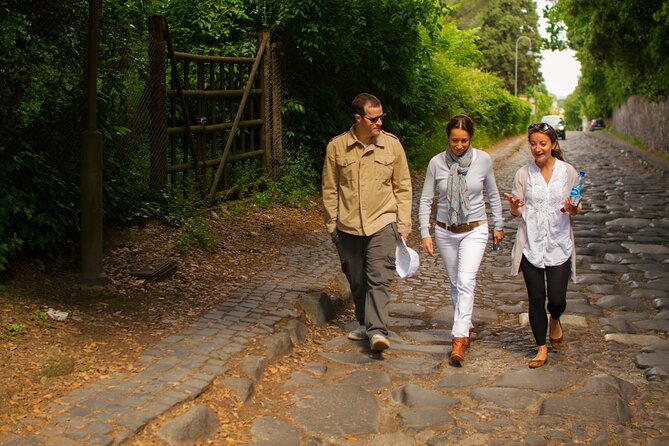
The first proper stop is the Via Appia Antica, one of Rome’s oldest roads. You walk for about 25 minutes along a route lined with ancient ruins and tombs.
The pleasure here is physical. You are walking on old paving stones, not simply looking at them behind a barrier. The uneven surface helps you understand how roads worked in the Roman world, although it also means you should wear sturdy shoes. Sandals are a poor choice if your feet are sensitive or you dislike uneven ground.
This stop is not a long archaeological lecture with endless remains. It is a short, atmospheric walk that sets the theme for the rest of the outing. Guides such as Andre, Francesca, and Antonella have been praised for making the road understandable through clear explanations, historical context, and small details.
You may hear about Roman expansion, the road’s use by armies and merchants, and the tombs that lined the route. The guide may also bring in the Mithraic religion, a secretive Roman-era faith that remains difficult to understand fully. That subject is one reason this tour can appeal to people who already know the headline stories of Roman history.
Cecilia Metella and the power of Roman tombs
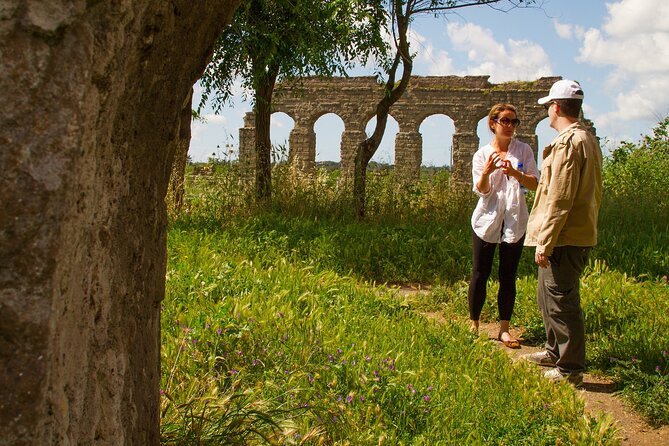
The next stop is the Mausoleum of Cecilia Metella, with about 25 minutes to see it and hear its story. This large circular tomb dates to the first century BCE and was built for a woman from a powerful Roman family.
The monument shows how burial was also public display. A tomb along the Appian Way could announce family status to everyone passing by. You are not just looking at a round stone structure. You are seeing an ancient statement of wealth, memory, and political importance.
The visit is fairly short, so do not expect a long independent exploration. The guide’s explanation does much of the work. This is one of those places that becomes more interesting when someone explains who built it, why it was placed along the road, and how it survived through later centuries.
The stop also breaks up the walking. You are outside the dense center of Rome, with more room around you and fewer competing monuments demanding attention. For many people, that change of pace is welcome after a morning among the Colosseum crowds.
More Catacombs and Underground City Tours in Rome
- Rome: Guided Roman Catacombs Tour with Transfers
★ 4.6 · 1,830 reviews - Rome: Catacombs Guided Tour with Transfer
★ 4.2 · 1,808 reviews - Rome EBike Tour: Appian Way, Catacombs & Roman Aqueducts
★ 5.0 · 1,766 reviews - Rome: Catacombs and Capuchin Crypt Guided Tour with Transfer
★ 4.6 · 1,606 reviews
The Aqueducts Park and Roman engineering
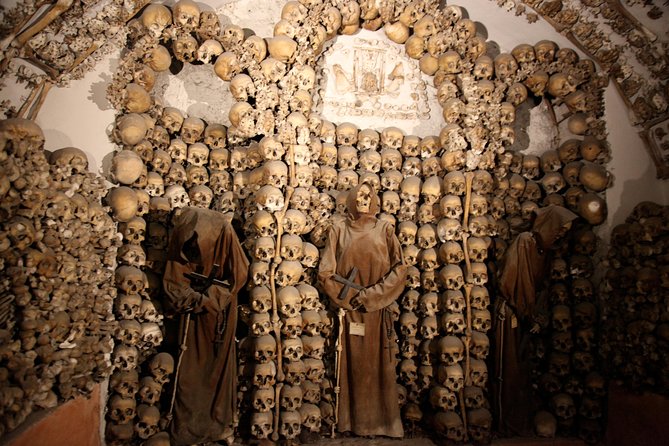
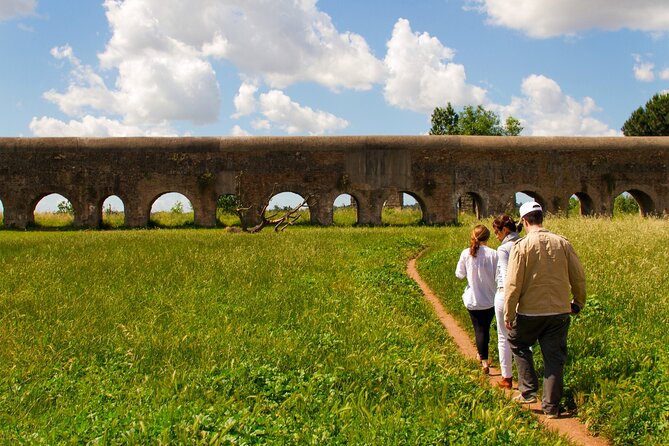
The aqueduct stop lasts about 45 minutes at Parco degli Acquedotti, part of the Appian Way Archaeological Park. Here, the remains of Rome’s aqueducts rise across open ground, giving you a clear sense of their size and purpose.
The aqueducts carried fresh water toward the ancient city. Their survival makes Roman engineering easier to grasp than a diagram in a museum. You can look up at the arches and consider the planning, labor, and maintenance required to keep water moving over long distances.
This is one of my favorite parts for visitors who enjoy how things work. The Appian Way shows the movement of people and goods. The aqueducts show the movement of water. Together, they explain why Rome could support a large urban population.
The walk here is not described as especially long, but you should bring water. Parts of the park are exposed, and one hot-weather visit reached nearly 100 degrees. The catacombs may be cool underground, but the aqueduct stop can still be tiring in strong sun.
Some guides focus closely on the technical side of the aqueducts, while others give a broader overview of Roman history. If you want detail, ask questions. Guides such as Annamaria, Chiara, and Francesca have been singled out for lively explanations and careful attention to the group.
Going underground at San Sebastiano or Domitilla
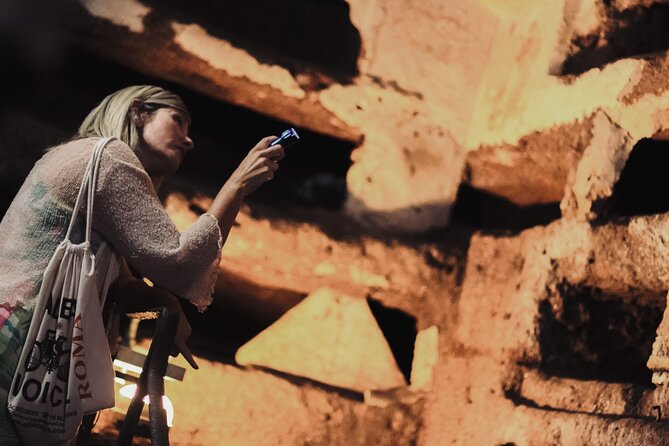
The final major stop lasts about one hour and 20 minutes, making it the longest part of the outing. Depending on the day, you visit the Catacombs of San Sebastiano or the Catacombs of Domitilla.
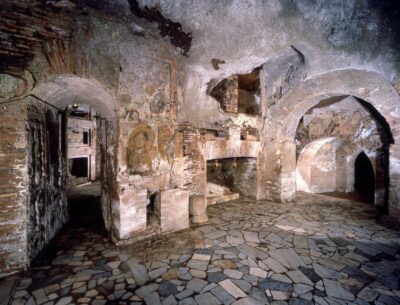
At San Sebastiano, you enter narrow underground passages connected with early Christian burial. The walls and chambers offer a look at Rome’s religious past that is very different from the grand public buildings above ground. You may see ancient frescoes and burial spaces, though the remains are not presented as a room full of exposed bones.
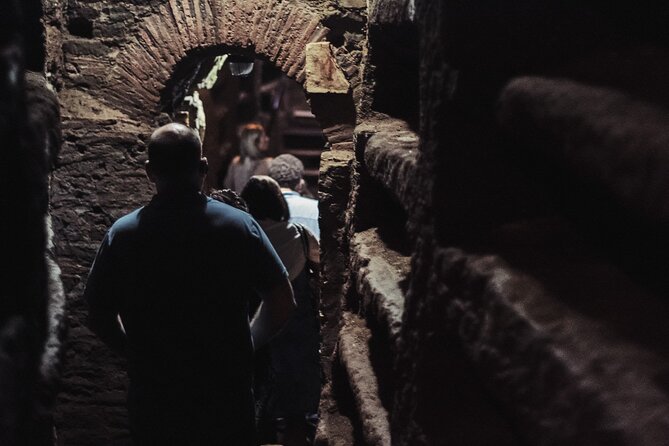
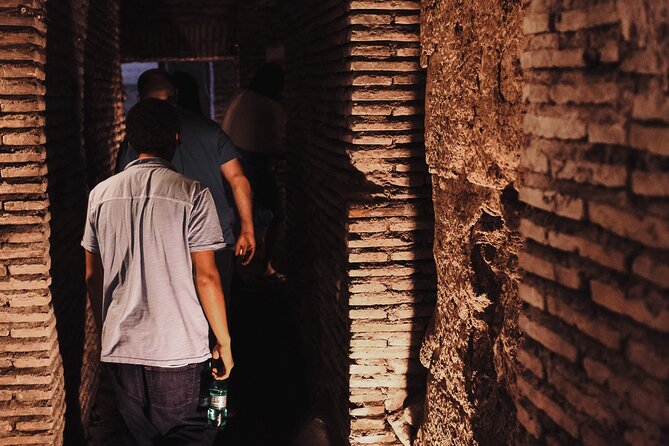
The catacombs can feel eerie, quiet, and surprisingly peaceful. The temperature is cooler than outside, but some passages may feel stuffy. If you have claustrophobia, this is the one part of the tour to consider carefully. The passages are tight, and this is not an open-air ruin where you can easily step away from the group.
A guide working at the catacombs leads the underground portion. That matters because the setting needs explanation. Without context, a series of tunnels can blur together. With a good guide, you learn how the burial spaces were used and how early Christian practice fits into the wider story of Rome.
The late-day timing is a strong feature. The group is scheduled as the last visitors of the day, creating a calmer mood than a busy daytime entry. It does not guarantee complete solitude, and the specific catacomb depends on the schedule, but it gives this part of the tour a distinctive finish.
One useful expectation: the catacombs are not equally appealing to everyone. If you prefer engineering, roads, and outdoor ruins, the underground visit may be your least favorite section. If religious history and ancient burial customs interest you, it may be the highlight.
What the guide adds to the experience
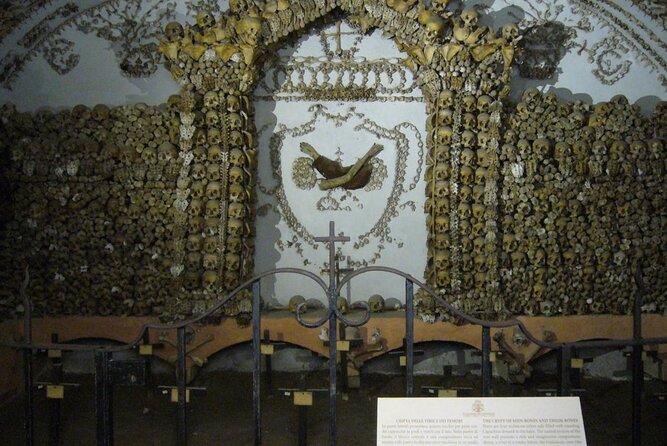
This tour depends heavily on the guide. The places are worthwhile, but the Appian Way and aqueducts do not come with the same obvious visual drama as the Colosseum. A good explanation turns scattered stones and arches into a connected story.
The guides assigned to different departures have included Sylvia, Antonella, Francesca, Andre, Annamaria, Flavia, Chiara, Paris, and Ali. The repeated praise for the guiding centers on enthusiasm, clear narration, humor, and the ability to keep a group engaged for more than three hours.
You may use headsets, which can help when standing outdoors near a group. One visit had clear audio equipment and a clean, comfortable bus. Ask questions when you have them, especially if you want more detail on the aqueduct system, Mithraic beliefs, or the family behind Cecilia Metella’s tomb.
The guide at the catacombs is separate from the main guide in some arrangements. This can be helpful because the underground section requires specialized information and careful group management.
Walking, weather, and comfort
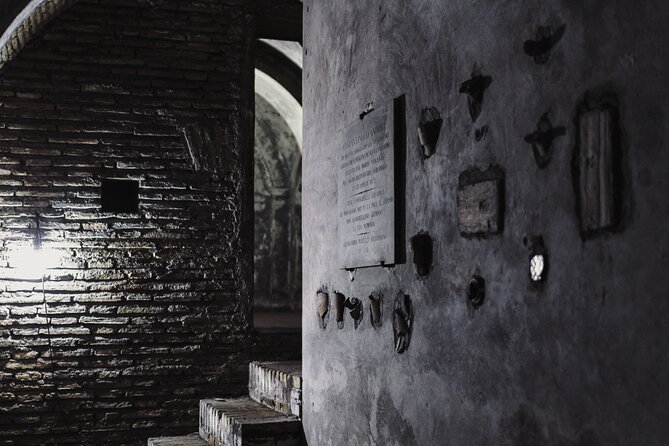
This is described as a moderate walking tour, not a coach ride with brief photo stops. You walk on uneven ancient road surfaces, spend time outdoors at the aqueducts, and move through underground passages.
Bring:
- Comfortable walking shoes with good grip
- A bottle of water
- Light clothing for warm outdoor conditions
- A layer for the cooler catacombs
- Patience for uneven ground and a steady group pace
Most people can take part, but you should be comfortable walking at a moderate pace. If you are not very fit, reaching the Piramide meeting point may itself require planning. Hotel pickup and drop-off are not included.
The minibus helps greatly with comfort, especially in hot weather. It also keeps the schedule realistic. You would lose a great deal of time trying to connect these sites independently.
Is $65.30 a fair price?
At about $65.30, the tour offers solid value for someone who wants these particular places. Admission to the catacombs and Aqueducts Park is included, as is an English-speaking guide and transport in an air-conditioned minibus.
The value is strongest when you consider the logistics. The Appian Way, Cecilia Metella, aqueducts, and catacombs are outside the usual center route. A self-guided visit would require extra planning, transport, and research. The tour packages those problems into one afternoon.
The value is weaker if you are choosing between this and Rome’s essential sights during a very short stay. The Colosseum, Roman Forum, and Vatican offer more famous monuments and usually deserve priority for a first visit. This outing is best when you already have time for those or when your main interest is ancient Roman infrastructure and early Christianity.
The 4.8 rating from more than 1,000 reviews and the 95 percent recommendation rate point to a consistently strong experience, but the fit still depends on your interests. The catacombs are not for everyone, and the outdoor stops can feel brief if you want a long, detailed archaeological visit at each location.
Who should book this Rome outing?
I would choose this tour if you want to see a side of Rome that many first-time itineraries skip. It suits you especially well if you enjoy roads, water systems, Roman engineering, tombs, and religious history.
It also works nicely early in a longer stay, once you have seen the main center. One person found it a good choice after arriving tired from a flight, since the minibus reduces the need to navigate several sites alone. That can work, although you still need enough energy for walking.
Families can enjoy it because the subjects change often. The road, tomb, aqueducts, and catacombs offer different kinds of history, and the small group makes it easier to stay connected. Very young children or anyone uncomfortable underground may find the final stop less suitable.
You should skip it if you strongly dislike confined spaces, have difficulty walking on uneven surfaces, or have only two days in Rome and still need to see the Colosseum and Vatican. You should also know that San Sebastiano and Domitilla are not interchangeable in atmosphere, so do not book this expecting one specific catacomb unless the date confirms it.
Should you book it?
Book this tour if you have at least three or four days in Rome and want more than the standard ancient sights. The combination of the Appian Way, Cecilia Metella, aqueducts, and catacombs gives you a broader picture of Roman life and infrastructure.
Skip it for now if this is your first short weekend and your central sights are not yet covered. For the right schedule, though, $65.30 is a reasonable price for the transport, admissions, small group, and guiding. Wear good shoes, carry water, confirm the Piramide meeting point, and be ready for an outing that is more thoughtful than spectacular.
FAQ
How long does the tour last?
The tour lasts approximately three hours and 15 minutes, including transport between the sites and the return to the meeting point.
Where does the tour begin?
It begins near the Piramide Metro station in Rome, at Piramide, 00154 Rome. Check the exact meeting instructions carefully because the pyramid landmark and metro station can be confused.
Where does the tour end?
The tour ends back at the original meeting point near Piramide.
Which catacombs will I visit?
You visit the Catacombs of San Sebastiano or the Catacombs of Domitilla, depending on the day.
Is transportation included?
Yes. Transportation between the sites is provided in an air-conditioned minibus. Hotel pickup and drop-off are not included.
How large is the group?
The group has a maximum of 18 participants.
Is the tour suitable for someone with claustrophobia?
The catacombs have tight underground passages, so anyone with claustrophobia may want to choose another activity. You should also be able to walk at a moderate pace without difficulty.
Just added around Rome
- Rome: Exclusive Colosseum Underground and Roman Forum Tour★ 4.8 · 569 reviews
- Rome: Colosseum Underground and Arena Floor Tour★ 4.4 · 59 reviews
- Catacombs of Saint Agnes Entry Ticket & Guided Tour★ 4.5 · 72 reviews
- From Rome: Capri Guided Day Trip with Blue Grotto★ 4.2 · 199 reviews
- Rome: Appian Way, Catacombs & Aqueducts by eBike + Transfer★ 4.9 · 421 reviews
- Private Guided Tour of Colosseum Underground OR Arena and Forum★ 5.0 · 111 reviews
- Hidden Gems & Rome Catacomb Semi Private Tour by golf cart★ 5.0 · 114 reviews
- Private Tour of Catacombs and Ancient Appian Way (hotel pick up)★ 4.5 · 120 reviews
Rome Cave Tours, compared.
Colosseum: Underground and Ancient Rome Tour
Read our review →
Rome: Capuchin Crypts and Catacombs Tour with Transfers
Read our review →
Expert Guided Tour of Colosseum Arena OR Underground, and Forum
Read our review →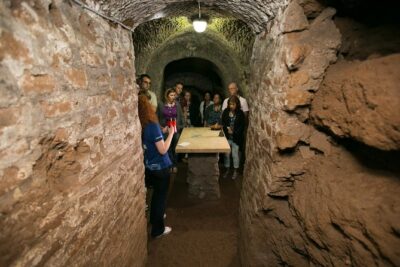
The Original Roman Crypts and Catacombs Tour with Transfers
Read our review →
Rome: Colosseum Underground Small Group Guided Tour
Read our review →
Rome: St. Peter’s Basilica, Dome Climb, and Underground Tour
Read our review →
Rome: Colosseum Underground, Arena & Forum Tour
Read our review →