REVIEW · ROME
Rome: Appian Way & Catacombs Golf Cart Shared Tour
The most surprising thing about this tour is how quickly Rome changes. Only about 3 kilometers from the Colosseum, you leave city traffic behind for the ancient Appian Way, open countryside, ruined tombs, and old stone roads. A golf cart makes this vast archaeological park manageable in three hours.
I like the small group of up to five and the mix of outdoor ruins with a real catacomb visit. Guides such as Federico and Shannon have been praised for clear English, strong storytelling, and bringing the ancient setting to life. The main drawback is that the tour does not include the aqueducts, and the catacombs require about 50 uneven steps each way.
Key points at a glance
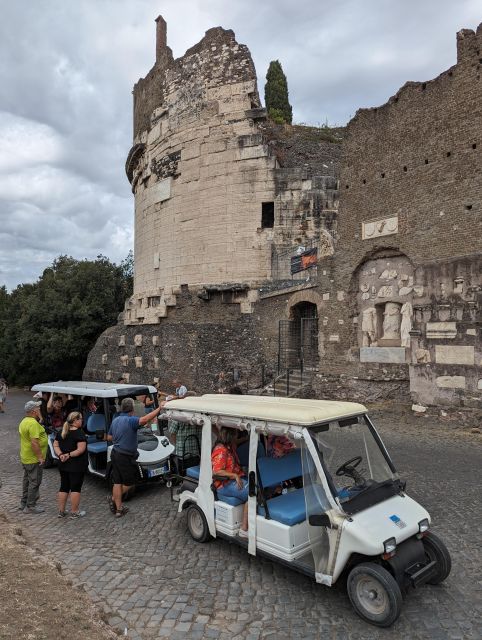
- Ride the ancient Appian Way: See the road linked with Spartacus, Roman generals, emperors, tombs, and Christian history without spending the day walking between scattered sites.
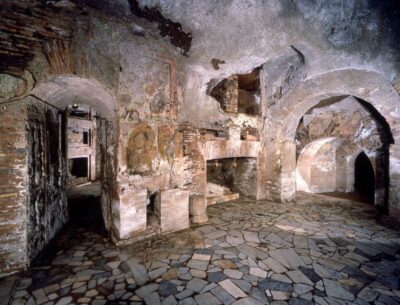
- Enter Rome’s catacombs: The 50-minute guided visit takes you underground, where the temperature is about 16°C and the stone steps are irregular.
- Travel in a very small group: With no more than five participants, it is easier to hear the guide and ask questions.
- See the Circus of Maxentius: This impressive ancient complex was also used as a setting for Ben Hur.
- Pass major sites efficiently: The route includes the Tomb of Cecilia Metella, Capo di Bove, and Villa dei Quintili, though some are viewed only from outside.
- Know what is missing: The aqueducts area is not part of this three-hour route.
Why the Appian Way feels so different from central Rome
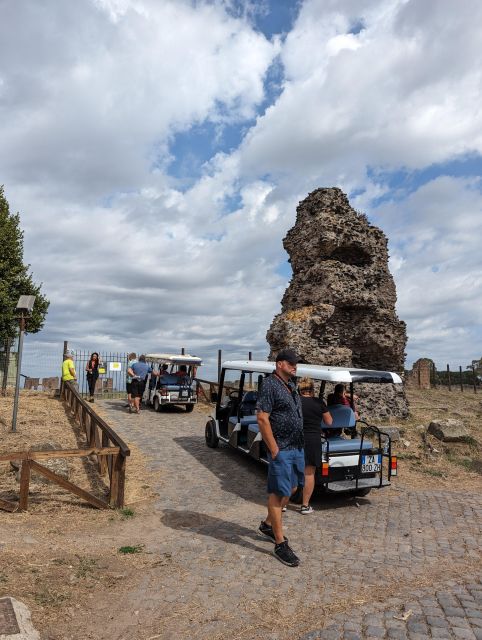
Most first visits to Rome focus on the Colosseum, Pantheon, Trevi Fountain, and Vatican. Those places matter, but they also bring crowds, queues, and a steady stream of city noise. The Appian Way offers a different side of Rome, one shaped by long roads, scattered ruins, burial monuments, and open space.
The park covers about 4,580 hectares. That size explains why a golf cart is useful. You can cover far more ground than on foot while still moving slowly enough to see the old road and hear the guide. This is not a quick transfer from one monument to another. The ride itself is part of the experience.
The Appian Way carries more than two thousand years of stories. Spartacus and his 6,000 enslaved followers were defeated in this region, while later Roman emperors and wealthy families left their own marks along the road. Your guide connects those events to the physical remains, which makes the ruins easier to understand than a simple list of dates.
I especially like the contrast with central Rome. You are still close to the city, yet the setting feels quiet and rural. That change of pace is valuable if you have already spent a day squeezing through crowded streets or waiting in lines.
More Catacombs and Underground City Tours in Italy
- Rome: Capuchin Crypts and Catacombs Tour with Transfers
★ 4.6 · 6,456 reviews - The Original Roman Crypts and Catacombs Tour with Transfers
★ 4.5 · 4,896 reviews - Rome: Catacombs of St. Callixtus Entry Ticket & Guided Tour
★ 4.6 · 3,037 reviews
Starting at Via Appia Antica 60
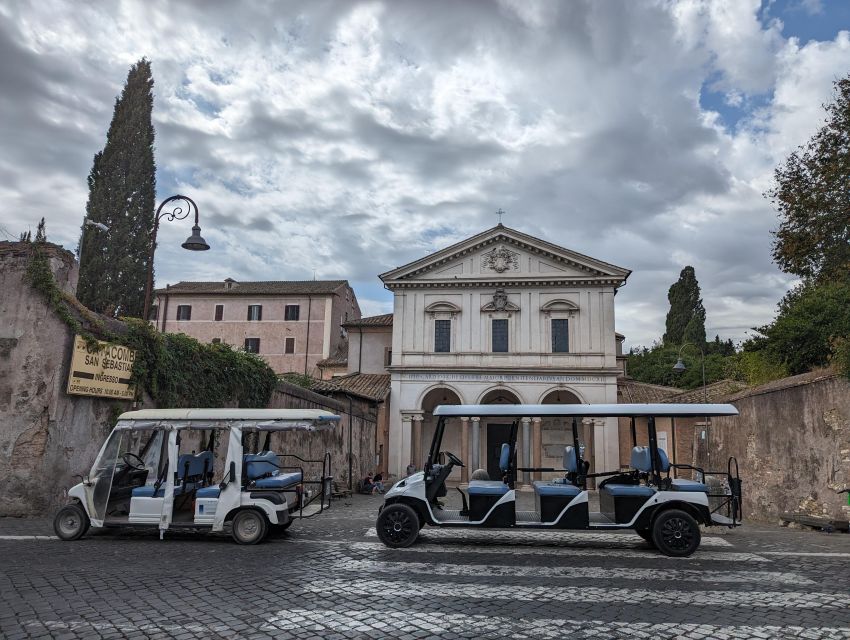
The meeting point is at Via Appia Antica 60. Plan to arrive 10 minutes early, then check in at the desk before the golf cart leaves. Hotel pickup and drop-off are not included, so you need to make your own way to the starting point.
The tour lasts three hours and is conducted in English. Starting times vary, so you should check availability before booking. Since the group is limited to five people, the setting is more personal than a large bus tour. You can usually follow the guide’s explanations without straining to hear, and a small group makes it easier to pause for questions.
The included half-liter bottle of water per person is a modest but useful touch. Food and other drinks are not included, so do not expect a meal stop during the tour. Three hours is long enough to see the main highlights, but short enough to fit beside other Rome plans.
Riding along the Appian Way
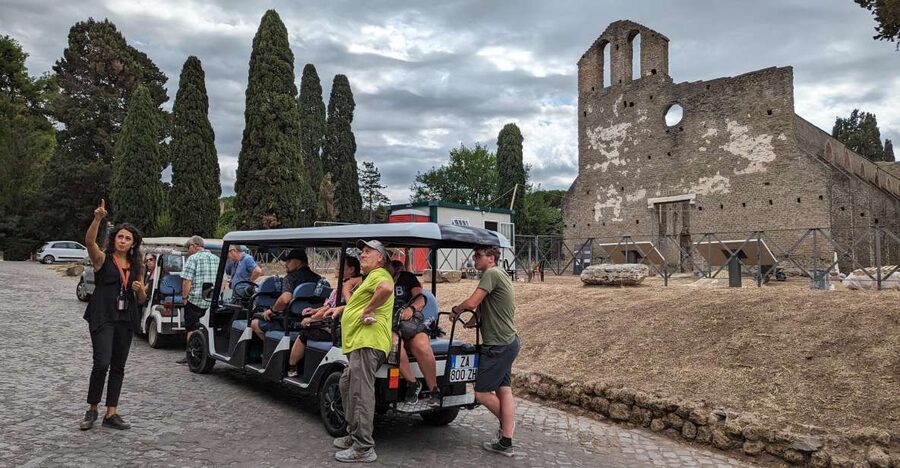
The first part of the route introduces the ancient road itself. The guided ride includes scenic views and about 10 minutes specifically noted for Appian Way sightseeing, though the road remains the thread connecting the rest of the trip.
The Appian Way was not simply a pleasant country lane. It was a major Roman road, built for movement, trade, military control, and communication. The guide uses the surviving road and nearby monuments to explain how important this route once was.
This is also where the stories of Spartacus, Crassus, and Commodus begin to connect. Spartacus is tied to the brutal defeat of his revolt, while Crassus represents the Roman power that put it down. Commodus belongs to a later period, but his presence enters the tour through the nearby Villa dei Quintili and its political intrigue.
The golf cart is a good match for the route. You get fresh air and views rather than a sealed vehicle window, but you do not have to walk the entire length of a huge archaeological park. Bring a light layer if you are sensitive to cool air, especially if your tour takes place before or after the underground visit.
The catacombs and the 16°C underground visit
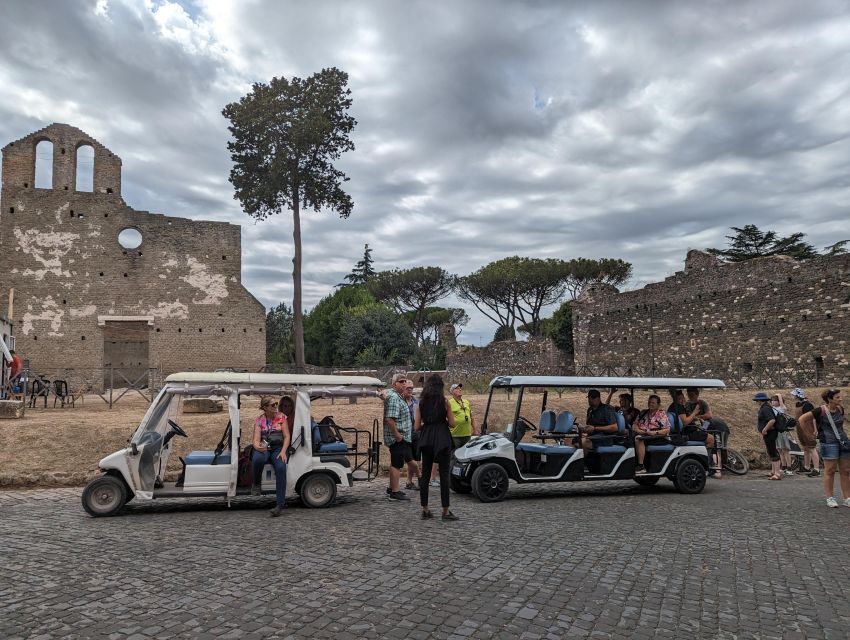
The catacombs are the most distinctive part of the experience. The entrance fee and guided visit are included, and the underground portion lasts about 50 minutes.
Here, law and faith meet in a hidden world below the road. The catacombs show how burial and religious practice developed away from the grand public monuments of imperial Rome. The guide’s job is important because the underground passages can otherwise feel like a confusing series of dark corridors and stone walls.
The temperature is about 16°C, so a light sweater or jacket is sensible even on a warm Roman day. You should also wear practical shoes. Wheelchairs are not permitted because of architectural barriers, and you must descend about 50 irregular steps, with roughly the same number to climb afterward. There is no lift and no place to sit along the way.
This restriction is not a minor footnote. The catacomb visit is a major reason to book the tour, but it also determines who can comfortably take it. The activity is not suitable for wheelchair users, pregnant women, or children under two. Pets are not allowed.
The catacomb guide may be a separate guide from the golf cart guide. That can produce a different style of presentation. Federico and Shannon have been praised for strong explanations and vivid storytelling on the outdoor portion, while one report found the on-site catacomb presentation too fast and emotionless. That does not mean every underground guide will be the same, but it is fair to expect the two parts to feel somewhat different.
More Catacombs and Underground City Tours in Rome
- Rome: Guided Roman Catacombs Tour with Transfers
★ 4.6 · 1,830 reviews - Rome: Catacombs Guided Tour with Transfer
★ 4.2 · 1,808 reviews - Rome EBike Tour: Appian Way, Catacombs & Roman Aqueducts
★ 5.0 · 1,766 reviews - Rome: Catacombs and Capuchin Crypt Guided Tour with Transfer
★ 4.6 · 1,606 reviews
Circus of Maxentius and the world of Roman spectacle
After the underground visit, the route continues to the Circus of Maxentius. This was one of the largest circuses in ancient Rome, built for public events and racing. Its scale helps you picture how much space Roman entertainment required.
The site also has a modern film connection: it was used as a setting for Ben Hur. That detail gives the ruins an easy point of reference, but the ancient purpose is the real reason to stop. The guide explains how the circus fit into imperial power and public life.
This is one of the places where a guide adds real value. Broken walls and open ground do not always explain themselves. With context, the site becomes a place built for mass spectacle, political display, and competition. Without that context, you might simply see another set of old stones.
The tour includes a guided visit here, so you get more than a passing view from the golf cart. At the same time, the three-hour schedule means the stop is not an extended archaeological study. If you want long independent visits at every monument, a private full-day outing would suit you better.
The Tomb of Cecilia Metella and Capo di Bove
The Tomb of Cecilia Metella is one of the best-known monuments along the Appian Way. The tour passes by it rather than offering a full interior visit. Even from the route, the tomb helps show how wealthy Roman families marked their presence along an important road.
The woman named Cecilia Metella remains partly mysterious, while the monument is linked to a powerful and wealthy Roman family. The tour also connects her tomb to the fortunes of Crassus, one of Rome’s richest men. This is a good example of the Appian Way’s appeal: personal stories and social power are written into the roadside monuments.
Capo di Bove receives a guided stop. The name refers to the area’s ancient remains, and the site adds another layer to the route beyond the major circus and catacombs. Your guide can place it in the wider setting of Roman roads, villas, burial grounds, and later Christian use.
The difference between these two stops matters. At the Tomb of Cecilia Metella, you mainly pass by and take in the monument as part of the road. At Capo di Bove, you have a guided visit. If a particular monument is your top priority, check how much time is spent there before booking.
Villa dei Quintili and the shadow of Commodus
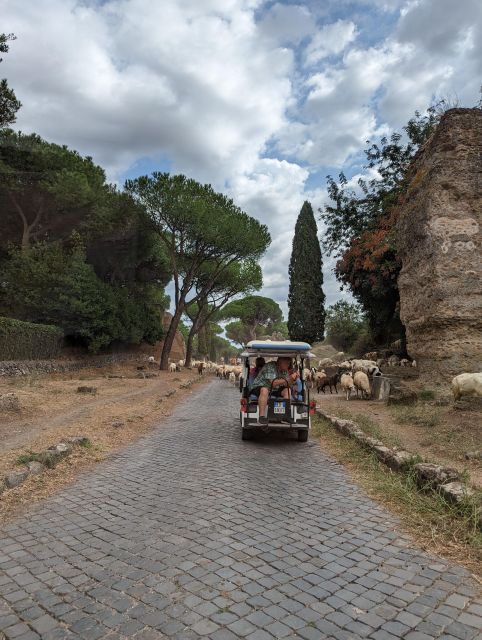
Villa dei Quintili is another major site on the route, but the tour passes by rather than entering for a full visit. The villa is tied to the Quintili brothers and to plots involving Emperor Commodus.
That story gives the ride a political edge. Ancient Rome was not only about temples, roads, and public games. It was also a place of suspicion, rivalry, wealth, and danger. The villa helps show how powerful families could attract both privilege and imperial attention.
Because you pass by Villa dei Quintili, do not book this activity expecting an extended tour of the villa’s interior. The stop works best as part of the wider story told from the golf cart. You see more locations in one outing, but you give up the slower examination that comes with a dedicated archaeological visit.
Guide quality and group size
The guide can make or break a history tour, and this experience places a lot of weight on that role. Federico has been praised for excellent English, friendliness, and detailed explanations about Italy’s past and present. Shannon has also been praised for helping visitors picture how the sites once looked.
Those comments point to the strongest feature of the tour: interpretation. The Appian Way is spread out, and many ruins need explanation before they become meaningful. A good guide turns the road into a connected story instead of a string of unrelated stops.
The group limit of five helps. You are not trying to follow a guide through a crowd, and questions are less likely to disappear in the shuffle. It also makes the golf cart feel more like a guided outing than a standard sightseeing vehicle.
Still, guide quality can vary, and the catacomb portion may be led by someone different. If you value a highly theatrical presentation at every stop, keep that distinction in mind. The outdoor guide may be warm and conversational, while the underground explanation may be more formal.
Is $95 a fair price?
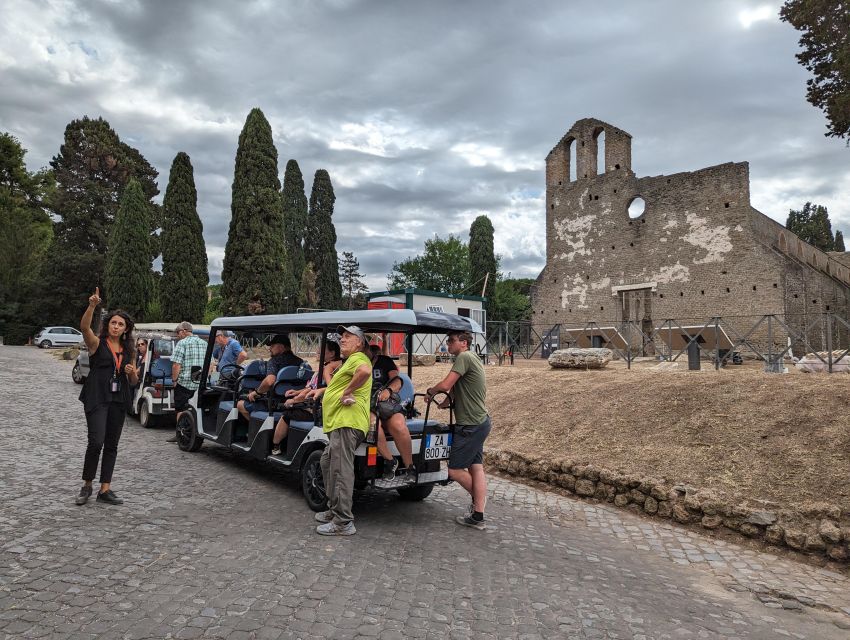
At $95 per person, this is not the cheapest way to see the Appian Way. The price includes three hours in a golf cart, an English-speaking local guide, a half-liter of water, and the catacomb entrance with its guided visit.
The value comes from combining transportation, interpretation, and admission in one compact outing. The park is enormous, and walking between these sites would take much longer. A standard taxi could move you around, but it would not provide the historical explanation or the catacomb entry.
The price makes the most sense if you want convenience and context in a short amount of time. It is less appealing if you plan to spend a full day in the park, want to enter Villa dei Quintili, or mainly want to visit the aqueducts. The aqueducts area is not included, so do not assume this route covers every famous Appian Way sight.
Free cancellation up to 24 hours before departure and reserve-now, pay-later booking add flexibility. Those policies are useful when your Rome schedule is still changing, but they do not change the basic question of value: you are paying for a small group, a guide, and access to the catacombs, not a full archaeological tour of every site.
Who should book this Appian Way outing?
I would choose this tour if you want to see a quieter side of Rome without giving up expert explanations. It suits first-time visitors who have already seen the central monuments, repeat visitors looking for something different, and anyone who prefers a guided route to planning several scattered sites alone.
It is also a good fit if the catacombs interest you. The underground visit adds something that a simple road tour cannot provide, and the included entry keeps the booking straightforward.
You should think twice if you use a wheelchair, have trouble with uneven steps, are pregnant, or dislike enclosed underground spaces. The catacombs require a significant stair climb, and there is no lift or seating on the way.
Families with children under two cannot join. Older children may find the history fascinating, but the activity still includes a formal archaeological and catacomb visit rather than a child-focused program.
Should you book it?
Book this tour if you want the Appian Way, catacombs, and major roadside ruins in one well-organized three-hour visit. The small group, golf cart transport, and strong outdoor guides such as Federico and Shannon make it a practical choice for seeing a large area without exhausting your legs.
Skip it if the aqueducts are your main goal, you need step-free access, or you want long visits inside Villa dei Quintili and the Tomb of Cecilia Metella. For the right visitor, $95 buys a useful mix of Rome’s ancient road, underground Christian history, imperial politics, and peaceful countryside close to the city center.
FAQ
How long is the Appian Way and catacombs golf cart tour?
The tour lasts three hours, including the golf cart route, guided stops, and the catacomb visit.
Where does the tour start and finish?
It starts and ends at Via Appia Antica 60. You should arrive 10 minutes early and check in at the desk.
Is the tour conducted in English?
Yes. The tour includes a live English-speaking guide.
How many people can join the golf cart tour?
The group is limited to five participants.
Is the catacombs entrance included?
Yes. The catacombs entrance fee and guided visit are included.
How many steps are in the catacombs?
You must descend about 50 irregular steps and climb about 50 steps afterward. There is no lift or seating along the way.
Is the tour wheelchair accessible?
No. Wheelchairs are not permitted in the catacombs because of architectural barriers, and the activity is not suitable for wheelchair users.
Are the aqueducts included?
No. The aqueducts area is not included in this route.
Just added around Rome
- St. Peter’s Basilica Full Guided Tour with Vatican Grottoes★ 4.6 · 286 reviews
- Rome: St Peter’s Basilica Express Tour & Grottoes★ 4.3 · 126 reviews
- St. Peter’s Basilica and Vatican Grottoes Tour★ 4.9 · 120 reviews
- Rome: Appian Way, Aqueducts, & Catacombs E-Bike Guided Tour★ 4.9 · 54 reviews
- Rome: Underground Trastevere Guided Walking Tour★ 4.8 · 87 reviews
- Rome: Tour of St. Clement’s Basilica Underground Temples★ 4.8 · 242 reviews
- Rome underground hidden temples, ruins, and secret basilicas★ 3.7 · 21 reviews
- Rome: St. Peter’s Basilica Tour with Vatican Grottoes★ 4.5 · 314 reviews
Rome Cave Tours, compared.
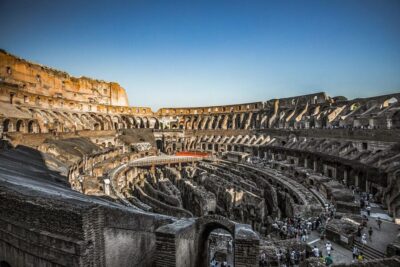
Colosseum: Underground and Ancient Rome Tour
Read our review →
Rome: Capuchin Crypts and Catacombs Tour with Transfers
Read our review →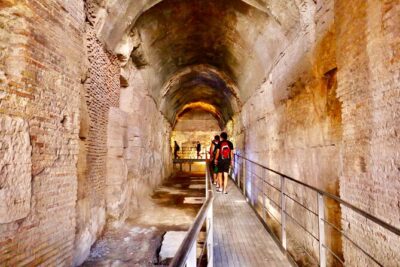
Expert Guided Tour of Colosseum Arena OR Underground, and Forum
Read our review →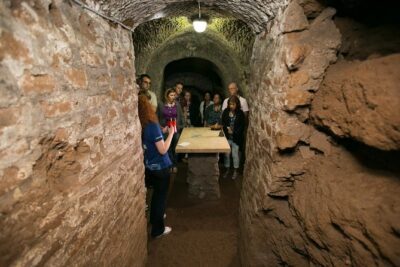
The Original Roman Crypts and Catacombs Tour with Transfers
Read our review →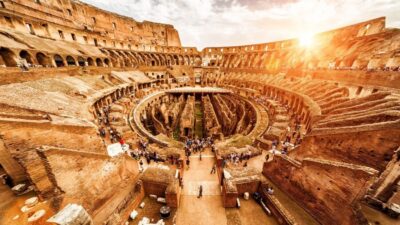
Rome: Colosseum Underground Small Group Guided Tour
Read our review →
Rome: St. Peter’s Basilica, Dome Climb, and Underground Tour
Read our review →
Rome: Colosseum Underground, Arena & Forum Tour
Read our review →