
REVIEW · HISTORICAL
Boston: Underground Railroad History Tour of Beacon Hill
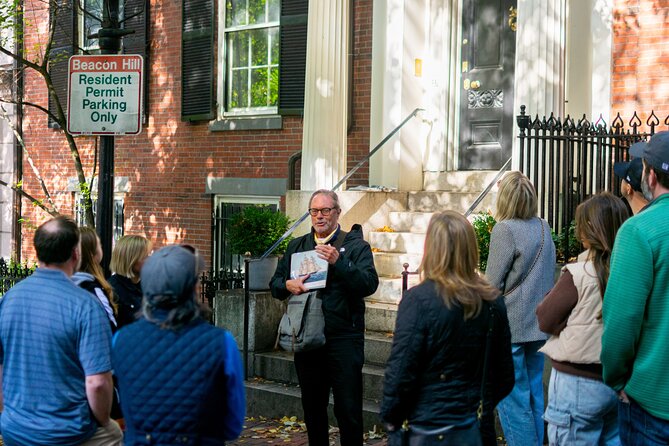
Boston’s role in the fight against slavery comes into sharp focus on this walking tour of Beacon Hill. You’ll visit the African Meeting House, the Haydens’ former safe house at 66 Phillips Street, and the home of abolitionist John J. Smith while learning how local Black leaders shaped the national struggle for freedom. The personal stories are the heart of the tour.
I like the small maximum of 16 people, which makes it easier to hear the guide and ask questions. I also like the way the route joins Boston’s Black history with the polished world of the Boston Brahmins, showing how two very different communities lived on the same hill. The tradeoff is simple: this is 2.5 hours of walking, standing, hills, cobblestones, and uneven pavement.
Key points to know before booking

- A focused Black history walk: Follow Boston’s Black Heritage Trail through homes, schools, churches, and memorials tied to abolition and the Civil War.
- Strong guides: Dana, Will, Lin, Meghan, Joe, and Drew are among the guides praised for clear storytelling, warmth, and command of the subject.
- A meaningful indoor stop: The African Meeting House, built in 1806, is included rather than viewed only from outside.
- A real walking commitment: Expect hills, narrow streets, uneven surfaces, and extended periods on your feet.
- Small-group format: The tour is capped at 16 people, giving the guide room to answer questions.
- Good value for history fans: At $35, the tour offers 2.5 hours of guided interpretation and admission to the African Meeting House.
Why Beacon Hill tells a bigger Boston story
Many people arrive in Boston expecting colonial landmarks, Revolutionary War sites, and the Freedom Trail. This tour shifts the focus to the people who challenged slavery, built institutions, organized communities, and helped push the country toward civil war.
The route follows the Black Heritage Trail through Beacon Hill, but it is not only a series of old buildings. Your guide connects each address to the people who lived there and to the difficult choices they faced. You’ll hear about abolitionists, teachers, legislators, veterans, activists, and families who helped freedom seekers.
The tour also gives you a useful contrast between Beacon Hill’s Black community and the wealthy white families known as Boston Brahmins. Acorn Street, with its tidy brick residences and narrow cobbles, introduces the elite side of the neighborhood. A few minutes later, Phillips School and the African Meeting House place you in the world of Black education, worship, political organizing, and resistance.
That contrast is one of the tour’s strengths. You do not simply look at beautiful buildings. You learn how power operated in Boston, who had access to education, who was excluded, and how local people fought to change the rules.
More History Tours in the USA:
- Beneath The Streets Underground History Tour
★ 4.5 · 8,006 reviews - Emerald Cave Express Kayak Tour with Scenic & Historic Stops
★ 5.0 · 1,522 reviews - NYC: History of Slavery & Underground Railroad Walking Tour
★ 4.7 · 87 reviews
Starting at Boston Common and the Soldiers and Sailors Monument
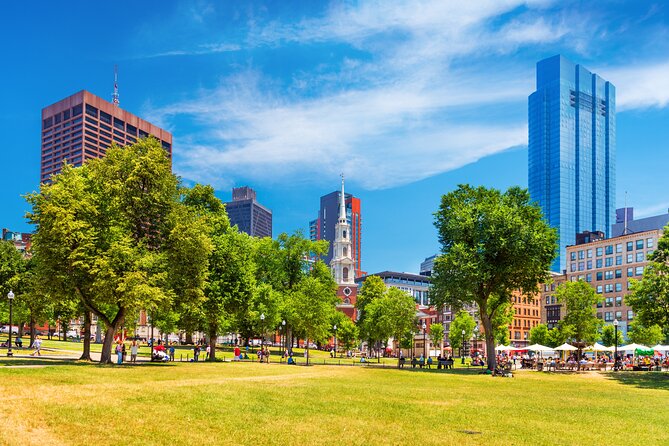
Meet at the Soldiers and Sailors Monument in the center of Boston Common, close to the Boston Common Visitors Center at 139 Tremont Street. The marker is easy to identify: a white granite column topped by a female figure holding a flag, with four bronze figures around its base.
This is a practical meeting point near public transportation and familiar city landmarks. Arrive with enough time to find the monument, since Boston Common has several statues and paths. The opening stop takes about 10 minutes and is free.
Boston Common itself adds useful context. It dates to 1634 and is described as the oldest public land in the Americas. It began as Boston’s shared grazing pasture, a reminder that this central park predates the city’s grand civic buildings by a long stretch.
From here, the group walks toward Beacon Hill. The route eventually returns close to the starting point, ending about 0.2 miles away at the Prescott House area near the Massachusetts State House.
Acorn Street and the world of the Boston Brahmins
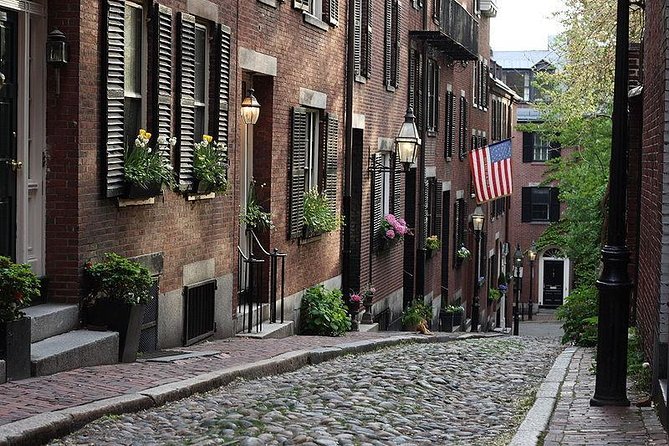
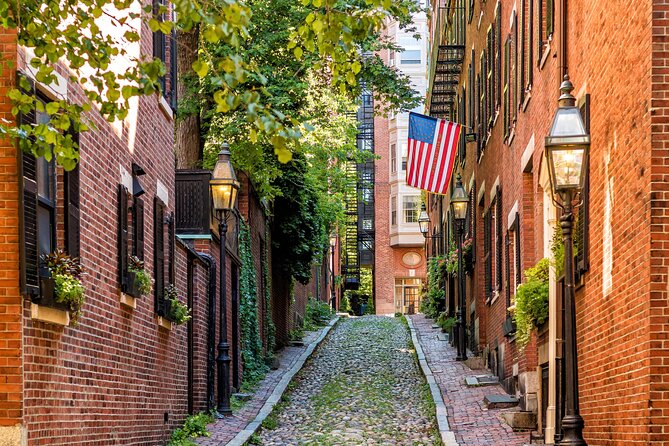
Acorn Street is one of Beacon Hill’s most recognizable corners. Its narrow cobblestones and historic homes are picturesque, but the guide uses the setting for more than a photo stop.
This is where you begin to understand the neighborhood’s elite side. The tour places the refined squares and residences of 19th-century Boston Brahmins beside the homes and meeting places of Black residents who were fighting for equal rights and freedom.
The stop takes around 10 minutes and costs nothing to enter because the experience happens outdoors. Keep in mind that Acorn Street is narrow and made of uneven stone. It can be awkward for anyone who has trouble walking on old surfaces.
Phillips School and the fight for integrated education
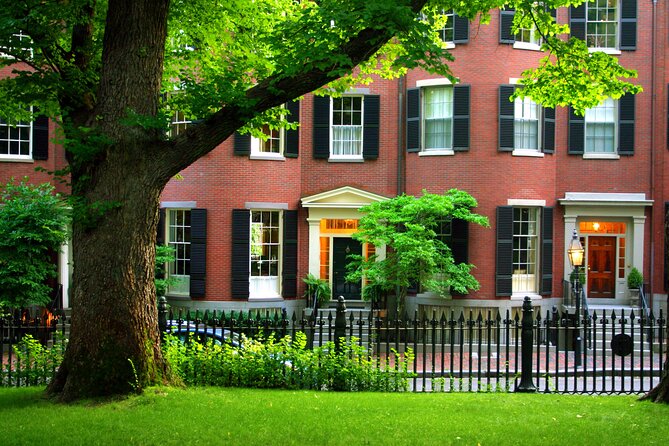
At Phillips School, the subject turns directly to racial inequality in Boston’s public education system. The building began in 1824 as a whites-only school, then became one of the first Boston schools to integrate by 1855.
This stop helps correct the easy assumption that Boston was automatically a progressive city because it opposed slavery. The city had its own systems of discrimination, and integration required pressure, organizing, and persistence.
You’ll spend about 10 minutes here. The value comes from the explanation rather than from a long interior visit. Your guide gives the building a place in the wider story of Black families seeking education and equal treatment.
A few more cave trips around the USA worth a look
- Best Niagara Falls US Tour W/Boat Ride, Cave & More Wonders!
★ 5.0 · 8,372 reviews - Half-Day Emerald Cave Kayak Tour with Optional Hotel Pickup
★ 5.0 · 4,978 reviews - Niagara Falls USA: Maid of the Mist & Cave Adventure
★ 5.0 · 3,924 reviews - New York Catacombs by Candlelight
★ 4.5 · 2,863 reviews
John J. Smith’s house and Beacon Hill’s Black leadership
The former home of John J. Smith brings the story down to one person. Smith was an abolitionist, a state legislator, and a barber. His house represents the civic and political strength of Boston’s Black community.
The tour uses this address to show that Black history in Beacon Hill is not only about people escaping slavery. It is also about residents who owned homes, ran businesses, entered politics, spoke publicly, and shaped policy.
The walk continues along Beacon Hill’s main thoroughfare, lined with shops and restaurants. That makes this a useful point to note the neighborhood’s present-day feel. You are moving through a living district, not an isolated museum complex, so the route mixes historic interpretation with ordinary city life.
Charles Street Meeting House and the hard work of reform
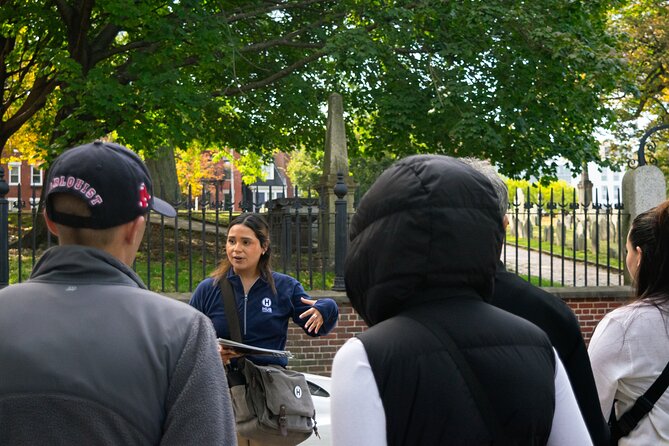
The Charles Street Meeting House dates to 1807 and is linked to heated arguments over racial integration. Your guide explains how religious spaces could become centers of public debate and political organizing.
The building is also a reminder that reform was rarely calm or tidy. Abolitionists had to argue, organize, publish, protest, and face opposition. The tour presents Boston as a place where anti-slavery ideas gained force, but where racial barriers remained very real.
This stop lasts about 15 minutes. You will view the site from the route, and admission is free. The guide’s storytelling matters here because the building alone cannot tell you why its debates were so important.
The Haydens’ safe house at 66 Phillips Street
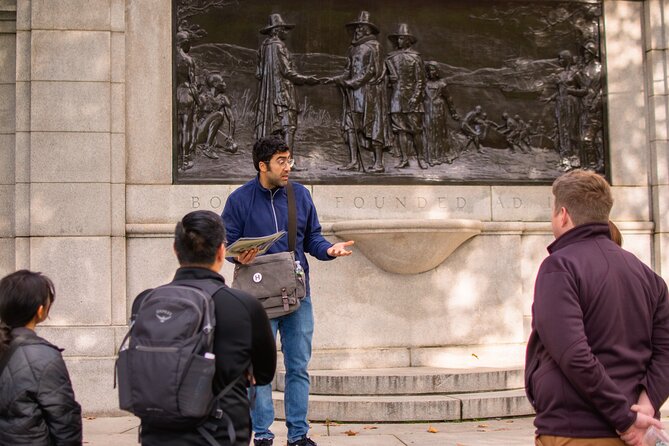
At 66 Phillips Street, the tour reaches one of its most compelling addresses. The house was owned by Lewis and Harriet Hayden, formerly enslaved people who became committed abolitionists. Their home served as an Underground Railroad safe house.
The stop lasts about 15 minutes. You learn how the house fit into the broader network that helped freedom seekers move away from slavery. The focus is not just on secret routes. It is also on courage, risk, planning, and the people who opened their homes despite the danger.
Some tours explain the Underground Railroad as a simple line running north. This stop gives you a more grounded picture. Freedom depended on homes, churches, allies, and quick decisions in places such as Beacon Hill.
Otis House and the people connected to power
Otis House dates to 1796 and was the residence of Harrison Gray Otis, a Boston mayor and nephew of Revolutionary figure James Otis, Jr. The address introduces another layer of Beacon Hill’s social order.
You are not asked to choose between the neighborhood’s famous white families and its Black community. Instead, the tour places them side by side. The grander political world represented by Otis House existed within walking distance of abolitionist homes, Black schools, and community institutions.
The route also passes an 1806 church designed by architect Asher Benjamin, the home of an outspoken abolitionist and U.S. senator who was beaten unconscious in the Capitol in 1856, and houses connected with several Black abolitionists, including historian William Cooper Nell.
These short stops help build momentum. You may not linger at every address, but the sequence shows how much political activity was packed into a few Beacon Hill blocks.
The African Meeting House, the tour’s central stop
The African Meeting House is the most substantial stop on the route. Built in 1806, it is the oldest surviving Black church building in the United States and served as a cultural center for Boston’s African-American community.
Admission is included, and the visit lasts about 25 minutes. This indoor portion breaks up the walking and gives the tour a place where the earlier stories can settle into a larger picture.
The building’s importance goes beyond worship. It was tied to education, community life, abolition, and public action. This is where the tour’s themes come together: Black Bostonians created institutions that supported families, spread ideas, challenged slavery, and demanded a fuller place in American life.
If you have a particular interest in Black history, this stop alone adds real value to the $35 price. You are not paying only for a walk past facades. You are getting guided context and entry to an important historic building.
5 Pinckney Street and an older Black Boston story
At 5 Pinckney Street, you’ll see the oldest surviving house in Beacon Hill, dating to 1787. It was home to an African-American veteran of the Revolutionary War.
This stop widens the timeline. The Black history of Boston did not begin with the Underground Railroad or the Civil War. Black residents had already served, worked, worshipped, raised families, and claimed a place in the city during the Revolutionary era.
The house is viewed from outside and takes about 10 minutes. It is a compact stop, but it helps you see Beacon Hill as a neighborhood with layers reaching from the Revolution through abolition and into the Civil War period.
The Massachusetts State House and the 54th Regiment Memorial
The route concludes near the Massachusetts State House, the building often associated with Boston’s role as the Hub of the Solar System. The tour ends across from the State House at the Robert Gould Shaw and the 54th Regiment Memorial.
The memorial honors Robert Gould Shaw and the 54th Massachusetts Regiment, one of the best-known Black Union regiments of the Civil War. Its placement makes sense after a tour about abolition, Black leadership, and Boston’s connection to the coming conflict.
This final stop brings the story from local streets to national events. The people and places you have seen were part of the pressure that helped make the Civil War possible and shaped the struggle to end slavery.
You finish near 26 Beacon Street, close to the State House and within easy walking distance of the starting area. That makes it convenient to continue sightseeing, find lunch, or return to Boston Common.
How much walking should you expect?
Plan on about 2.5 hours of walking and standing. The pace is measured, with regular stops, but Beacon Hill is genuinely hilly. You will also encounter cobblestones, narrow sidewalks, and uneven surfaces.
Wear comfortable shoes and bring water. This is not a good choice if standing for long periods is difficult. Service animals are allowed, and the tour is near public transportation.
The route is not presented as a strenuous hike, but younger children may find the length and amount of information tiring. It can work well for older children and teenagers with an interest in American history. One family found that ages 12 and 15 engaged well, while another noted that the 2.5-hour format could be too much for younger children.
The guides make a real difference
The strongest part of this experience is the guide. Dana is described as an engaging educator with a background in history teaching and the National Park Service. Will is known for strong Civil War knowledge, careful storytelling, and a clear love of the subject.
Lin is praised for making difficult material relatable and for keeping a steady pace. Meghan is noted for explaining the Underground Railroad clearly, while Joe and Drew are also described as polished, friendly, and well prepared.
Guide styles will naturally vary. One piece of practical feedback noted a guide checking the time often and shuffling visual materials. That may happen when the guide is trying to cover a large amount of material within the scheduled period. The upside is that you get a serious amount of information in one walk.
Is $35 a fair price?
At $35 per person, I consider this a good value if you want history rather than a quick photo walk. The tour lasts about 2.5 hours, includes a small group of no more than 16 people, covers all 10 Black Heritage Trail landmarks listed for the experience, and includes entry to the African Meeting House.
You are not paying for period costumes, museum admissions beyond the included site, or a theatrical performance. The value is in the guide’s interpretation, the carefully connected route, and the chance to understand buildings that could otherwise look like ordinary historic houses.
If you prefer a short overview of Boston, this may feel too long. If you want a serious look at abolition, Black community life, and the Civil War’s Boston connections, the price is modest for the time involved.
Who should book this Beacon Hill walk?
Book it if you enjoy history, ask questions, and are willing to walk slowly through an old neighborhood. It is especially useful early in a Boston visit because it gives deeper meaning to Beacon Hill, Boston Common, and the State House area.
This is also a strong choice for local residents. The route can reveal stories that are easy to miss even if you live or work in Boston. Families with older children, Civil War enthusiasts, and anyone interested in Black American history should find plenty to consider.
Skip it if you want a relaxed sightseeing loop with little standing. The subject is serious, and the route is long enough to require decent fitness. Bad weather can also cancel the experience, with a different date or full refund offered in that case.
Should you book it?
Yes, if the history interests you and your feet can handle Beacon Hill. The tour connects private homes, public institutions, schools, churches, and memorials into one clear story about Boston’s Black community and the fight against slavery.
Choose a morning or afternoon when you are not rushed. Arrive ready to listen, wear good shoes, and allow the guide’s stories to reshape the way you see one of Boston’s prettiest neighborhoods.
FAQ
How long is the Underground Railroad History Tour of Beacon Hill?
The tour lasts approximately 2 hours and 30 minutes.
How much does the tour cost?
The listed price is $35 per person.
Where does the tour begin?
It begins at the Soldiers and Sailors Monument in Boston Common, at 139 Tremont Street, near the Boston Common Visitors Center.
Where does the tour end?
It ends at the Robert Gould Shaw and the 54th Regiment Memorial near 26 Beacon Street, across from the Massachusetts State House.
Is admission to the African Meeting House included?
Yes. Admission to the African Meeting House is included in the tour.
Is this a private tour?
No. It is a small-group tour with a maximum of 16 travelers.
Is the tour offered in English?
Yes. The tour is offered in English and uses a mobile ticket.
How physically demanding is the tour?
You should expect considerable walking and standing, including hills, cobblestones, and uneven surfaces. A moderate level of physical fitness is recommended.
What is the cancellation policy?
You can cancel for a full refund up to 24 hours before the scheduled start time. Cancellations or changes made less than 24 hours in advance are not accepted for a refund. If poor weather or an insufficient number of participants cancels the tour, you will be offered another date or a full refund.
Just added around the USA
- Peninsula Park Caves Scenic Boat Tour★ 4.5 · 88 reviews
- Cave Point Kayak Tour★ 4.5 · 92 reviews
- Cave Point Kayak Tour★ 5.0 · 281 reviews
- Cave Point Kayak Tour★ 5.0 · 24 reviews
- Flagstaff Underground★ 5.0 · 39 reviews
- Snowshoe Hike to Castner Glacier Ice Cave★ 5.0 · 35 reviews
- Castner Glacier Ice Cave Adventure from Fairbanks★ 5.0 · 40 reviews
- Glacier Hiking & Geothermal Cave Pools Tour★ 5.0 · 139 reviews
Historical Tours, compared.
Prague: Oldtown, Medieval Underground & Dungeon History Tour
Read our review →
Prague Old Town, Medieval Underground and Dungeon Historical Tour
Read our review →
Edinburgh: Old Town and Underground Historical Tour
Read our review →

Emerald Cave Express Kayak Tour with Scenic & Historic Stops
Read our review →
Edinburgh: Witches & Haunted History Walking Tour
Read our review →
Rome: Ancient History and Colosseum Underground Tour
Read our review →Browse the lists this tour appears in