REVIEW · ROME
Rome: Appian Way, Catacombs, & Roman Aqueducts E-bike Tour
Rome’s best ancient sights are not all packed around the Colosseum. This 27-kilometer e-bike route carries you out along the Appian Way, past tombs and villas, then beneath the enormous arches of the Roman Aqueducts. It is a fine way to trade Rome’s traffic and crowds for open countryside without giving up the city’s remarkable past.
I like two things especially: the mix of history and fresh air, and the quality Cannondale bikes, which make a long ride manageable. Guides such as Oscar, Arina, Agnese, and Pablo are praised for clear explanations and careful riding. The main caution is simple: this is an intermediate ride, with uneven tracks, gravel, and some city traffic.
Key points to know before booking
- The six-hour version includes the Catacombs of St. Callixtus or St. Sebastian, while the four-hour version only stops at the entrance.
- About 60 percent of the 27-kilometer route is off-road, including bumpy sections on the Appian Way and through parks.
- The route connects several major Roman sights, including the Aurelian Walls, Circus of Maxentius, Tomb of Cecilia Metella, Villa dei Quintili, Aqueducts Park, Caffarella Park, and Baths of Caracalla.
- Traffic is part of the experience, especially during the city connections between the starting point, Appian Way, and Aqueducts Park.
- The electric assistance handles hills and distance well, but you still need to be comfortable steering and braking on uneven ground.
- Groups are limited to 10 people, and the guide speaks English, Italian, French, German, Spanish, or Dutch depending on the departure.
Why the Appian Way makes a better bike ride than a quick photo stop
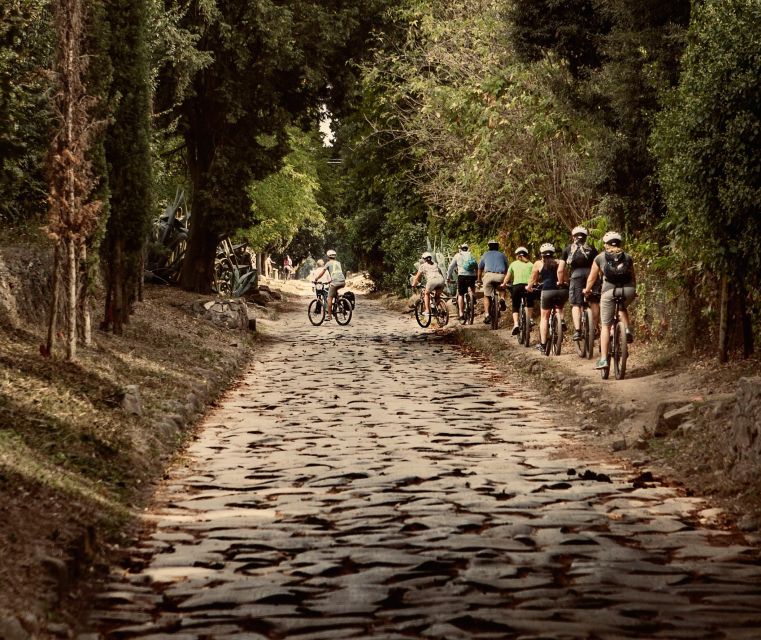
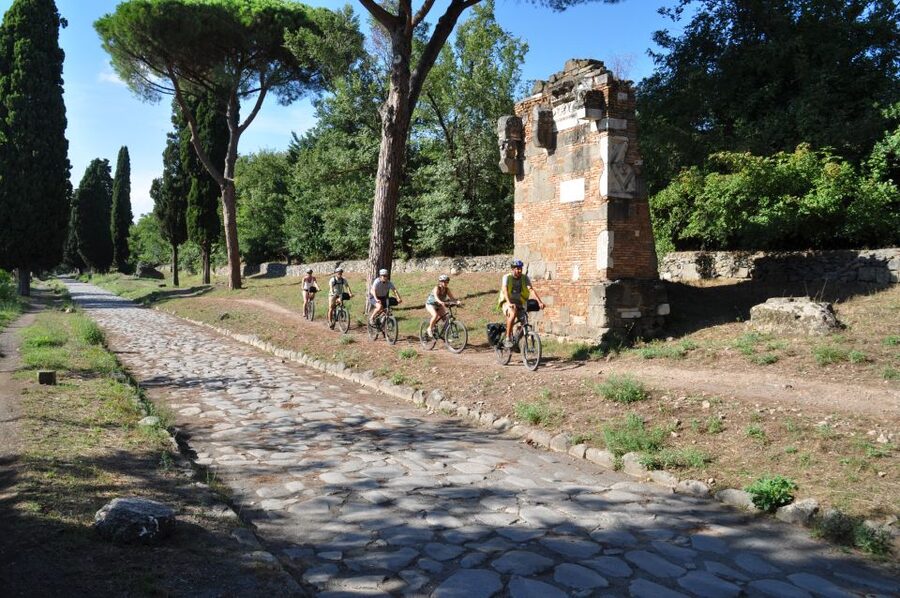
The ancient Appian Way, or Via Appia Antica, began more than 2,300 years ago as one of Rome’s great roads. It carried soldiers, merchants, officials, and messages south from the city. Today, its old route passes through a protected area where Roman ruins sit among grass, trees, and quiet country lanes.
A guided bike ride lets you understand the road as a whole. On foot, you would cover only a small stretch before tiring. In a car, you would miss the rough surface, the pauses, and the way the ruins appear one by one. The e-bike gives you enough range to see the road, the aqueducts, and the parks in one outing.
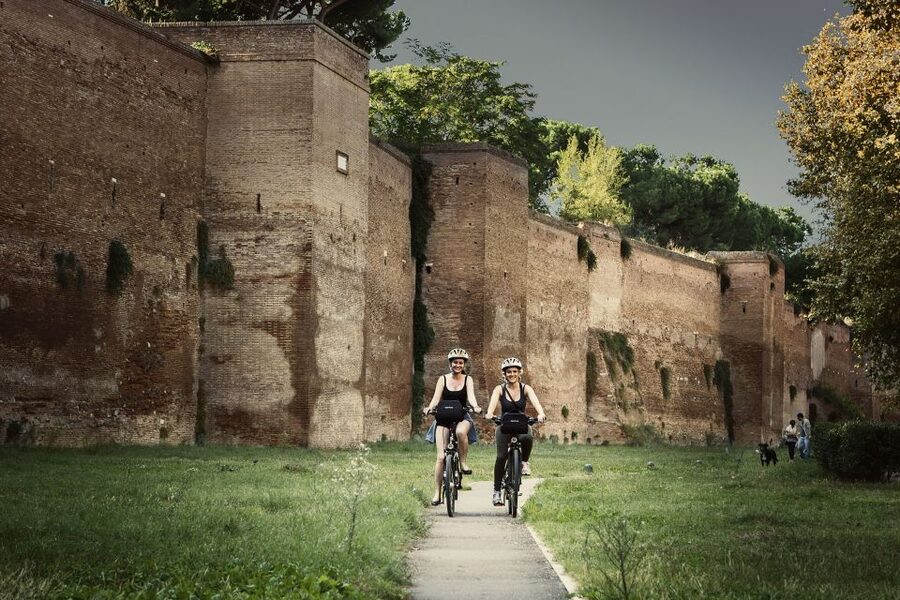
You begin at Via Labicana 49, within walking distance of the Colosseum and Manzoni Metro stations. From there, the route heads toward the Aurelian Walls and enters the ancient road through St. Sebastian’s Gate. The transition is satisfying: modern Rome gives way to stone, grass, and a much slower rhythm.
More Catacombs and Underground City Tours in Italy
- Rome: Capuchin Crypts and Catacombs Tour with Transfers
★ 4.6 · 6,456 reviews - The Original Roman Crypts and Catacombs Tour with Transfers
★ 4.5 · 4,896 reviews - Rome: Catacombs of St. Callixtus Entry Ticket & Guided Tour
★ 4.6 · 3,037 reviews
Crossing the Aurelian Walls and leaving central Rome

The Aurelian Walls were built in the third century to protect Rome as the empire faced growing threats. They are not just a scenic backdrop at the start. They explain the shape of the city and show where the dense urban core once ended.
The first section of the ride includes city streets. This matters because you need more than a basic ability to pedal. You must watch the guide, hold your line, use the brakes properly, and stay alert around traffic. The guides are careful about road crossings and keep the group together, but this is still Rome, not a closed cycling path.
Several riders with little e-bike experience found the controls easy to learn, especially with an introductory explanation from the guide. That said, I would not make this your first ever bicycle ride. If you are uncertain, practice on an e-bike before arriving, preferably somewhere without traffic.
The Catacombs: choose the six-hour tour for the underground visit
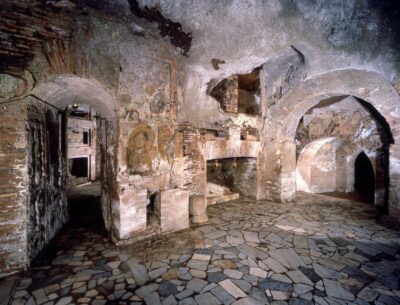
The catacomb stop is the clearest difference between the two versions. The six-hour tour includes a guided visit underground at the Catacombs of St. Callixtus or St. Sebastian. You walk through crypts and corridors while learning about early Christian burial customs and the religious history of Rome.
This is not a casual extra stop. The underground visit gives the route a different mood and adds an important layer to the Roman story. The Appian Way was not only a road lined with grand tombs. It also passed burial places used by early Christian communities outside the city walls.
The four-hour tour does not include entry. You stop at the catacombs’ entrance for roughly five minutes and hear an explanation of their importance before continuing. This shorter version works well if your priority is cycling through the parks and seeing the aqueducts, but the six-hour outing is the better value if you want the fullest historical program.
Food is not included in either option. Depending on the day and timing, you may have a chance to buy something along the way. Some departures include a stop at a pizzeria, and one reported stop was a simple roadside place rather than a polished restaurant. Think practical fuel, not a planned culinary experience.
Ancient tombs, aristocratic villas, and the Circus of Maxentius

Once on the Appian Way, the ride becomes more relaxed. You pass mausoleums, tombstones, and the remains of villas linked to Rome’s wealthy families. The guide pauses at several points, giving you time for photos and explaining what you are seeing.
The Circus of Maxentius is one of the most interesting stops because it shows the scale of Roman entertainment outside the better-known Circus Maximus. It was built during the reign of Emperor Maxentius and formed part of a larger complex that included a palace and mausoleum.
The Tomb of Cecilia Metella is another major landmark. Its round, fortress-like form is one of the Appian Way’s most familiar sights. Even from outside, it gives you a strong sense of how powerful Roman families marked their presence along this important road.
The remains are spread out, which is exactly why the bike is useful. You are not rushing from one isolated monument to another. You are moving through an archaeological area where ancient structures, pasture, and country roads share the same view.
More Catacombs and Underground City Tours in Rome
- Rome: Guided Roman Catacombs Tour with Transfers
★ 4.6 · 1,830 reviews - Rome: Catacombs Guided Tour with Transfer
★ 4.2 · 1,808 reviews - Rome EBike Tour: Appian Way, Catacombs & Roman Aqueducts
★ 5.0 · 1,766 reviews - Rome: Catacombs and Capuchin Crypt Guided Tour with Transfer
★ 4.6 · 1,606 reviews
Villa dei Quintili and the quieter side of Rome
The route continues past the Villa dei Quintili, a large suburban residence built for two wealthy brothers and later taken over by Emperor Commodus. Its size tells you that Roman luxury did not stop at the city gates. The emperors and elite wanted space, gardens, and country retreats within reach of Rome.
You do not need to be an ancient-history expert to enjoy this section. The guide’s job is to turn scattered stone into a readable story. Guides such as Agnese, Ali, Cas, and Bita have been praised for giving useful detail without talking nonstop, which is important on a long ride. You need enough information to understand each site, plus time to look around and enjoy the setting.
This is also where the route feels most different from a standard Rome sightseeing day. The city’s major attractions can be crowded and tightly scheduled. Here, you have stretches of quiet between stops. The ruins do not feel arranged for a quick queue and exit. You see them as part of the countryside.
The Roman Aqueducts: the visual high point
The Park of the Aqueducts is the tour’s most striking open-air stop. Long rows of arches cross the grass, sometimes running parallel in layers. These structures carried water into Rome from distant springs, allowing the city to support a huge population, public baths, fountains, and private homes.
The sheer scale is easier to grasp from a bicycle. You can ride alongside the arches, stop for photographs, and then follow their direction toward modern Rome. The aqueducts are not a single monument with one viewing platform. They stretch across the park, so the ride gives you changing views and a better sense of their length.
I particularly like this part for visitors making a second or third trip to Rome. It offers a side of the city that is easy to miss if you stay near the Colosseum, Pantheon, and Trevi Fountain. Families also tend to appreciate the change of pace. Teenagers who might find a long museum visit dull often respond well to the movement and the scale of the ruins.
The park itself is not a perfectly smooth cycling surface. Gravel and rough patches are part of the route. The Cannondale e-mountain bikes have anti-puncture tires and are built for this kind of riding, but they do not remove every bump. One rider would have preferred rear suspension, and that is a fair point if you are sensitive to jolts.
Caffarella Park and the ride back into Rome
After the aqueducts, the route crosses the green Caffarella Valley. This section helps tie the ancient sites together. Rome’s expansion did not erase every open area outside the old walls, and the valley gives you another view of the city’s edge.
The return route includes some city riding before you reach the starting point. The full trip is roughly 40 percent urban and 60 percent in parks or on off-road paths. That split is useful to remember. Promotional images may focus on ruins and open fields, but you will also ride through carefully selected city streets to connect the sites.
The final listed sight is the Baths of Caracalla. These enormous public baths once included pools, exercise areas, libraries, gardens, and richly decorated halls. Seeing them near the end gives you one last reminder of how much public infrastructure Rome built for ordinary city life, not just for emperors.
How hard is the 27-kilometer ride?
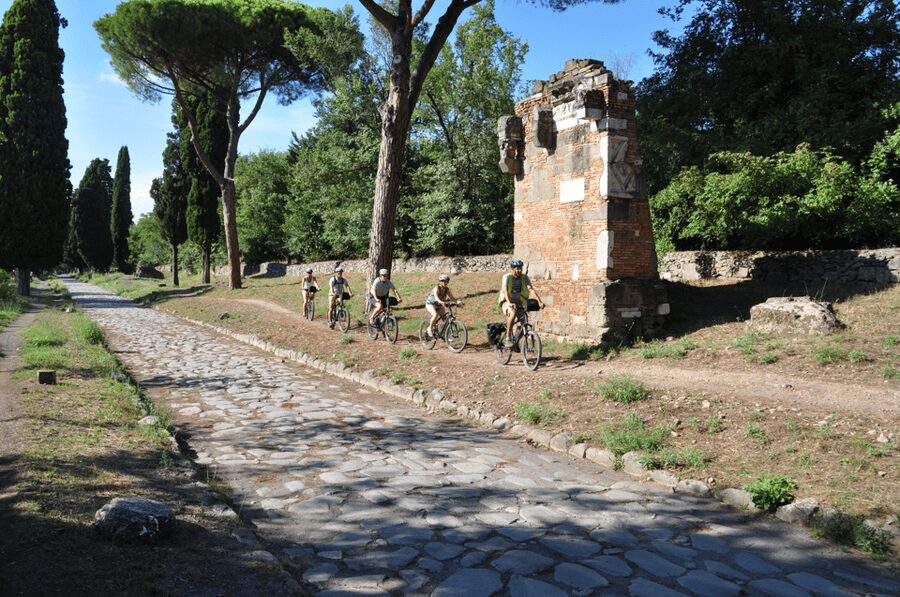
The electric motor reduces the effort of hills and distance, but it does not turn the route into a sightseeing bus. The stated level is intermediate, and that is accurate. You need basic control on gravel, uneven stone, and narrow sections, along with enough stamina to remain on the saddle for several hours.
The route is listed as 27 kilometers, or about 17 miles. Some riders recorded close to 16 miles on the six-hour version. The e-bike assistance means you can pedal the full route without exhausting yourself, but you still need to steer, balance, brake, and react to the surface.
The equipment includes:
- A Cannondale quality e-mountain bike
- Anti-puncture tires
- Helmet, which must be worn
- A five-liter handlebar bag
- A biodegradable bottle of water
The equipment has a weight limit of 300 pounds, or 136 kilograms. Infants aged one to four can ride free in a child seat up to 49 pounds, or 22 kilograms. Children aged five to eight use a child extension, while children aged nine and older can ride an e-bike independently. The tour is specifically described as difficult with a child seat or extension, so families should think carefully about the uneven route.
Timing, weather, and group size
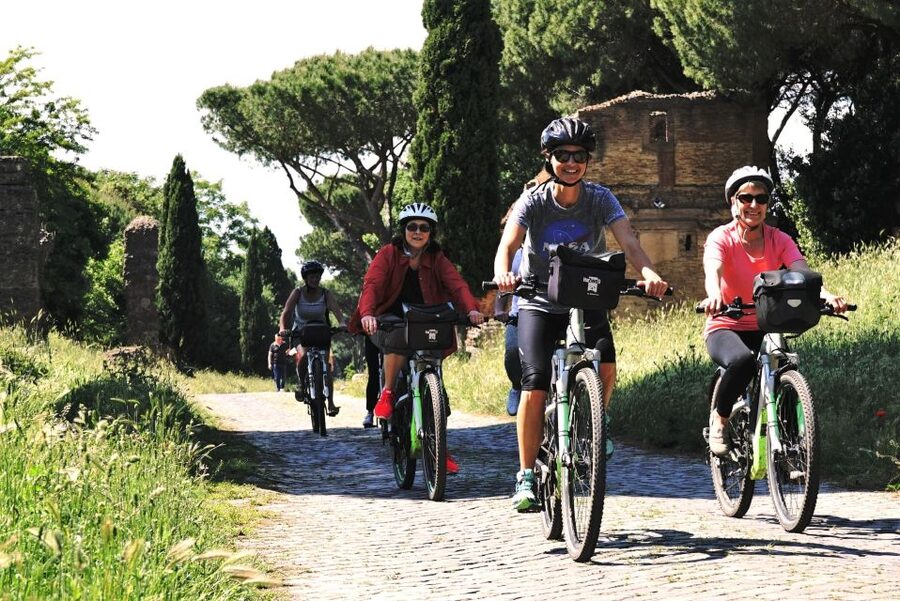
The tour lasts four or six hours depending on your booking. On Wednesdays, it can run about 30 minutes longer. Check the start time when booking, since departures vary.
A sunny day will show off the parks and aqueducts at their best, but warm weather means you need water and sun protection. The guides have made frequent water stops on hot days. Rain does not automatically ruin the outing, though wet gravel and ancient stone can make handling harder. Comfortable shoes are required, and practical clothing is a better choice than anything delicate.
Groups are limited to 10 people. That is a useful size for city riding because the guide can watch the group at crossings and stop to explain sights without turning the experience into a large procession. The minimum departure requirement is four participants. If that number is not reached, you are offered an alternative or a full refund.
The guides work in English, Italian, French, German, Spanish, and Dutch. Names that have received particularly strong praise include Oscar for his careful traffic handling and storytelling, Arina for pacing and safety, Agnese for detailed explanations, and Pablo for his warm, funny style. Your guide depends on the departure, but the recurring strength is the same: good route control matters as much as Roman facts here.
Is $85 a fair price?
At $85 per person, this is not the cheapest way to see a few ruins. It is a full half-day or longer outing with a quality e-bike, helmet, water, guide, and a route covering several areas that are awkward to combine on your own.
The price makes the most sense if you value three things: transport between distant sights, clear historical context, and a chance to get outdoors. Hiring bikes separately would still leave you to plan a safe route through Rome, find the Appian Way, connect to the aqueducts, and manage the return. The guide and route design are a large part of the value.
Choose the six-hour version if the catacombs matter to you. Choose four hours if you mainly want the Appian Way and aqueducts, or if a longer ride would strain your schedule. Food and drinks cost extra, so bring enough money for a stop along the route.
Free cancellation is available up to 24 hours ahead, and you can reserve now and pay later. Those policies help if your Rome plans are still shifting, but the bigger booking decision is the physical one: can you comfortably handle an intermediate ride?
Who should book this e-bike tour?
I would recommend it to active couples, families with older children, and anyone who wants Rome’s ancient sites with more space and movement. It is especially useful on a second visit, when you have already seen the central monuments and want a different side of the city.
You should be a confident bicycle rider, even if you have never used an e-bike. The motor is easy to learn, but it cannot steer through traffic or smooth out every rough patch. If you dislike gravel, have balance problems, or want a fully relaxed ride with no urban cycling, choose another way to see the Appian Way.
Should you book the four-hour or six-hour version?
Book the six-hour tour if you want the catacombs, more time for historical stops, and the fullest route. The extra two hours add the underground visit and allow the outing to feel less hurried.
Book the four-hour tour if the aqueducts and countryside are your main goals, or if you want a shorter active break from central Rome. You still ride the Appian Way, pass major ruins, cross the parks, and see the aqueducts, but the catacombs are only explained from the entrance.
For most visitors who can manage the distance, I would choose six hours. It turns a bike ride into a broad look at Roman roads, burial customs, imperial villas, engineering, and public life. Just remember that the route is active, partly rough, and not free from traffic.
FAQ
Where does the Rome e-bike tour start?
The tour starts at Via Labicana 49. From the Colosseum Metro station, walk about 10 to 15 minutes, passing the Colosseum and continuing along Via Labicana. From Manzoni Metro station, the walk takes about 10 minutes.
How long is the e-bike tour?
You can choose a four-hour or six-hour version. On Wednesdays, the tour can last about 30 minutes longer.
Does the tour include the Catacombs?
The six-hour version includes a guided visit to the Catacombs of St. Callixtus or St. Sebastian. The four-hour version stops at the entrance for about five minutes and explains their history but does not include the underground visit.
How far do you ride?
The route is about 27 kilometers, or 17 miles. Around 60 percent is off-road, while about 40 percent takes place on city streets used to connect the Appian Way with the Aqueducts Park.
Is the tour suitable for children?
Children aged one to four can ride in a child seat up to 49 pounds, or 22 kilograms. Children aged five to eight use a child extension, and children aged nine and older can ride an e-bike independently. The route is intermediate and is described as difficult with a child seat or extension.
What is included in the price?
The tour includes a Cannondale e-mountain bike with anti-puncture tires, a helmet, a five-liter handlebar bag, a biodegradable bottle of water, and a professional guide. A guided catacomb visit is included only with the six-hour option.
Do I need previous e-bike experience?
You do not need previous e-bike experience, since the guide explains how to use the bike and its assistance. You do need to be comfortable riding a bicycle, because the route includes gravel, uneven ground, and some city traffic.
Should you book this tour?
Book it if you want to combine Roman ruins with an active ride through parks and open countryside. Skip it if you want a completely smooth, traffic-free outing. For confident riders, the six-hour option offers the strongest value, while the four-hour tour is a sensible shorter version focused on the Appian Way and aqueducts.
More E-Bike Rides in Rome
- Rome: Appian Way & Catacomb Sunset E-bike Tour with Aperitif
★ 4.5 · 682 reviews - Rome: Appian Way, Catacombs & Aqueducts by eBike + Transfer
★ 4.9 · 421 reviews - E-Bike Mountain Tour in Natural Park +Option Tapas in a Cave
★ 4.7 · 63 reviews - Benagil e-bike tour 7 hanging valleys
★ 5.0 · 34 reviews
More Cycling Tours in Rome
- Rome: Appian Way & Aqueducts E-Bike Tour (Catacombs & Food)
★ 4.9 · 1,498 reviews - Appian Way Aqueducts Bike Tour (Catacombs & Lunch Option)
★ 5.0 · 975 reviews - Appian Way, Catacombs and Aqueducts Park Tour with Top E-Bike
★ 5.0 · 735 reviews - Rome: Appian Way E-Bike Tour Catacombs, Aqueducts & Picnic
★ 4.6 · 727 reviews
Just added around Rome
- Rome: Colosseum Underground and Arena Floor Tour★ 4.4 · 59 reviews
- Rome: Exclusive Colosseum Underground and Roman Forum Tour★ 4.8 · 569 reviews
- Catacombs of Saint Agnes Entry Ticket & Guided Tour★ 4.5 · 72 reviews
- From Rome: Capri Guided Day Trip with Blue Grotto★ 4.2 · 199 reviews
- Rome: Appian Way, Catacombs & Aqueducts by eBike + Transfer★ 4.9 · 421 reviews
- Hidden Gems & Rome Catacomb Semi Private Tour by golf cart★ 5.0 · 114 reviews
- Private Guided Tour of Colosseum Underground OR Arena and Forum★ 5.0 · 111 reviews
- Private Tour of Catacombs and Ancient Appian Way (hotel pick up)★ 4.5 · 120 reviews
Rome Cave Tours, compared.
Colosseum: Underground and Ancient Rome Tour
Read our review →
Rome: Capuchin Crypts and Catacombs Tour with Transfers
Read our review →
Expert Guided Tour of Colosseum Arena OR Underground, and Forum
Read our review →
The Original Roman Crypts and Catacombs Tour with Transfers
Read our review →
Rome: Colosseum Underground Small Group Guided Tour
Read our review →
Rome: St. Peter’s Basilica, Dome Climb, and Underground Tour
Read our review →
Rome: Colosseum Underground, Arena & Forum Tour
Read our review →